How AI Shopping Agents Are Changing Commerce: What Should Brands Prepare?
How will agentic commerce and AI shopping agents change online shopping? Learn how product recommendations, product pages, and structured data are shifting.
How will agentic commerce and AI shopping agents change online shopping? Learn how product recommendations, product pages, and structured data are shifting.
How will agentic commerce and AI shopping agents change online shopping? Learn how product recommendations, product pages, and structured data are shifting.
How will agentic commerce and AI shopping agents change online shopping? Learn how product recommendations, product pages, and structured data are shifting.
How will agentic commerce and AI shopping agents change online shopping? Learn how product recommendations, product pages, and structured data are shifting.
AI shopping agents now help people find and compare products, and in some cases they handle the purchase too. That changes what brands need to watch. Ranking in search results is no longer enough. When a shopper describes what they want, you also need to know whether the AI puts your product on its shortlist.
Getting ready for agentic commerce means reviewing your product pages, structured data, and product feeds, and measuring how AI answers mention and cite your brand. This post covers what is changing and the AI shopping optimization work brands should start on now.
Check your brand's AI search visibility with VIVI
AI shopping has moved past asking a chatbot for product ideas. Agents now interpret a shopper's requirements, search for products, and compare the options. Some can also help complete the purchase, but what's available depends on the platform, the seller, and the region.
Agentic commerce is a model of commerce where AI agents search for, compare, and help buy products based on what a shopper wants and the conditions they set.
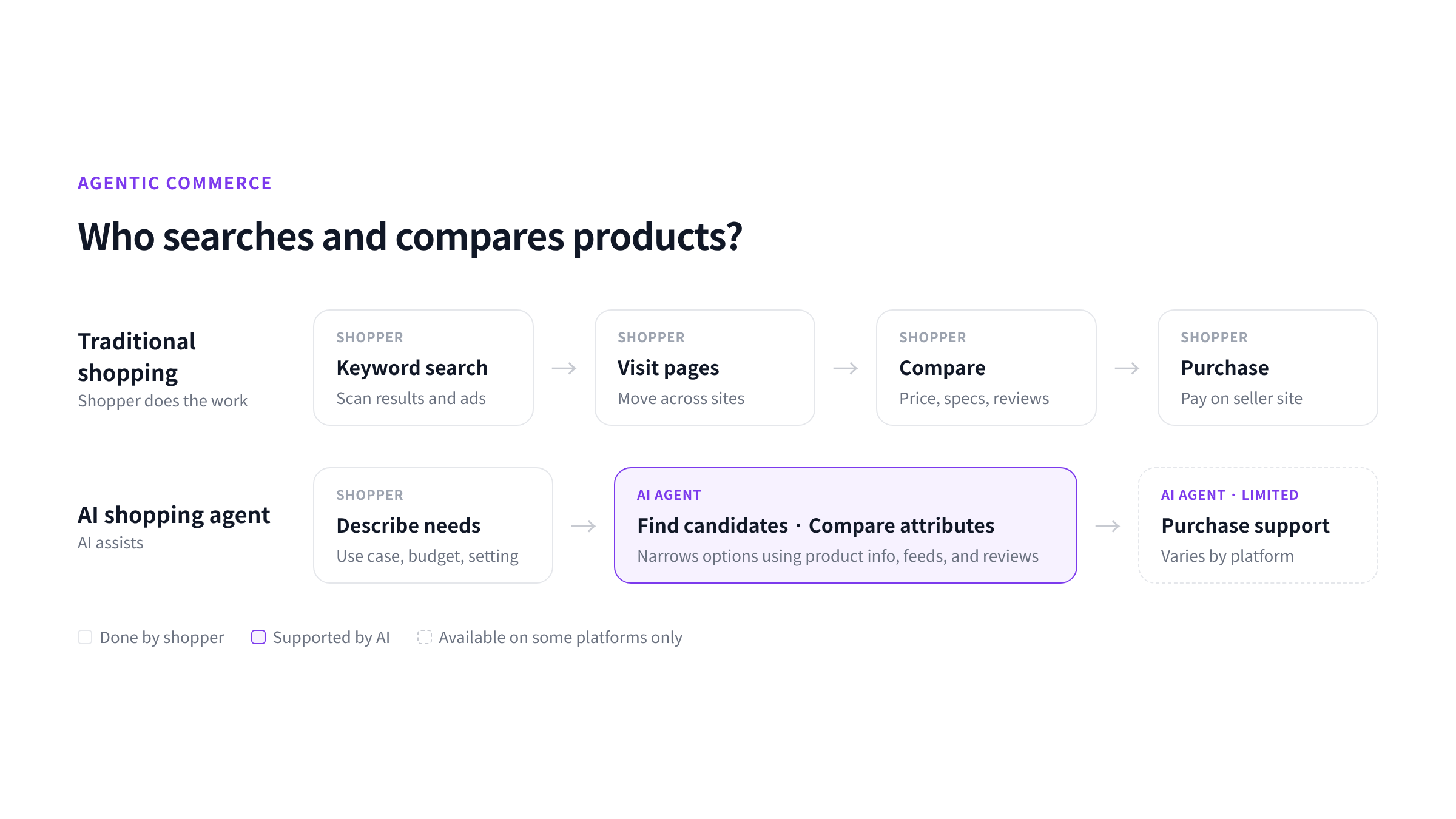
In November 2025, OpenAI announced shopping research. A shopper describes what they need in plain language, and the AI looks across multiple sources, compares the options against the shopper's criteria, and returns a summary of recommendations.
In March 2026, OpenAI expanded the experience with visual browsing and side-by-side comparison, and said it would extend the Agentic Commerce Protocol (ACP) to product discovery. ACP is an open standard that lets merchants send structured product information to ChatGPT.
Checkout inside ChatGPT is available for some merchants and products, not all of them. Brands should check what each platform supports and how their product information actually reaches it.
Google is also adding technology and services that link AI agents to merchant systems. It continued developing the Universal Commerce Protocol (UCP) through 2026, and on October 15 it launched Universal Cart in the US.
Universal Cart lets shoppers keep products from different merchants in one place and track price changes and promotions. The two companies take different approaches and offer different features. The direction is the same, though: AI is taking over the work of hopping between sites, and finding a product and buying it are moving closer together.
In traditional online shopping, brands earned clicks through top search rankings, ads, and thumbnails. Shoppers visited several product pages and compared prices, specs, and reviews themselves.
With AI shopping, the AI can do part of that work. Say a shopper asks for "a quiet air purifier for a small apartment." The AI can look past the category and weigh recommended room size, noise level, filter performance, and price to narrow down the options.
The product information a brand publishes is what the AI works from when it searches and compares. Search optimization still matters. You now have to manage search visibility and AI recommendation visibility together.
| Traditional online shopping | AI shopping | |
|---|---|---|
| How people search | Shopper scans search results | AI finds candidates based on the question and criteria |
| How products are compared | Shopper compares multiple product pages | AI organizes product attributes and helps compare them |
| What you compete on | Search rank, ads, thumbnails | Relevance to the question, product information, recommendations |
| Brand priority | Search visibility and clicks | Search optimization plus AI recommendation visibility |
| What you measure | Impressions, clicks, traffic, conversions | Also AI mentions, citations, and recommendation context |
Pay particular attention to queries that don't include a brand name. "Recommend a Samsung air purifier" comes from someone already interested in the brand. "Recommend a quiet air purifier for a studio apartment" comes from someone who hasn't picked a brand yet.
To see whether new customers can find you, look at where your products land in non-branded shopping queries built around use case, budget, taste, and setting.
You don't need to rebuild every product page for AI shopping. Start by checking whether your existing product information is clear and structured enough for both shoppers and AI to use.
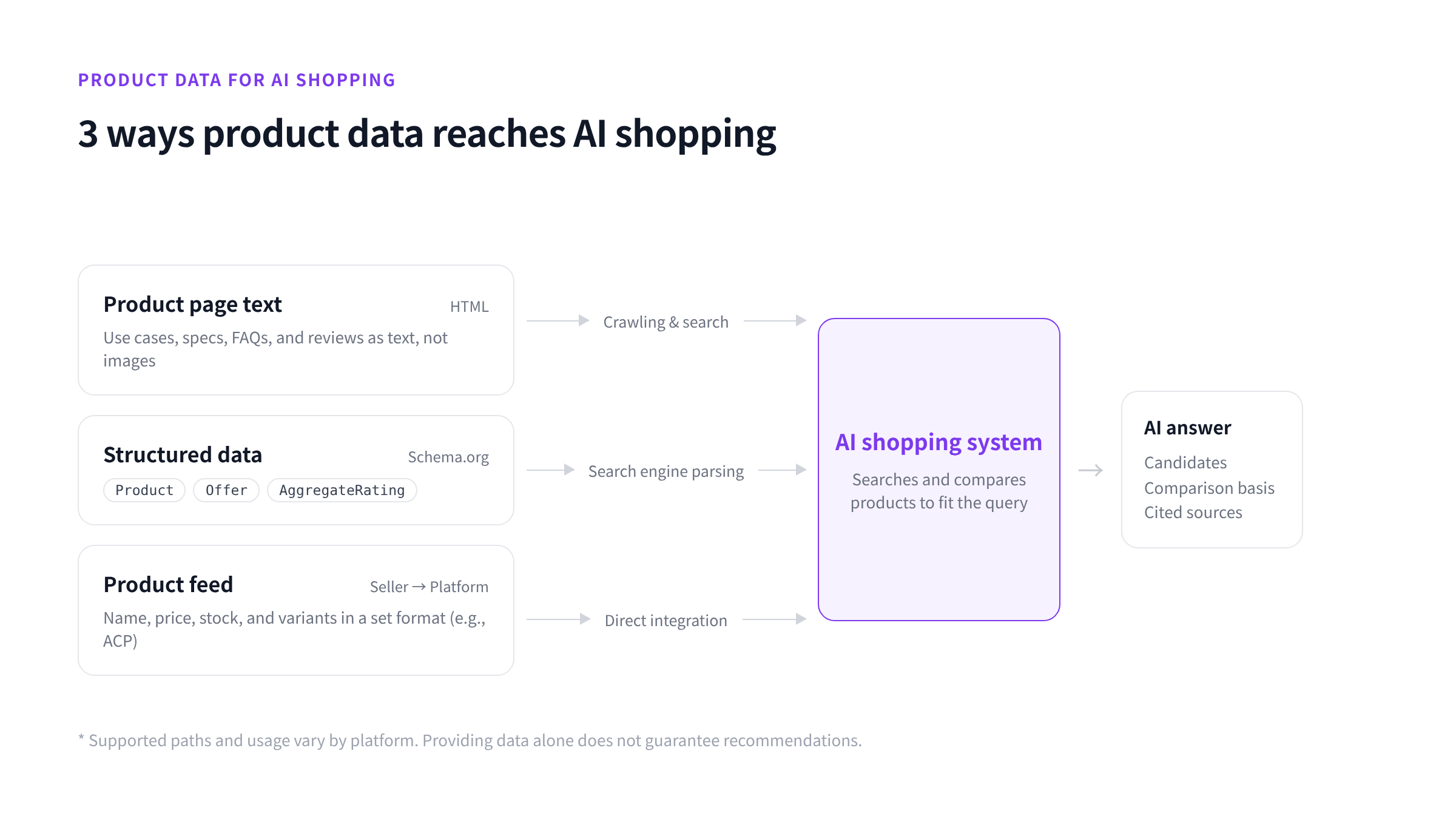
A product page is where shoppers learn about a product, and it's also a source AI can draw on when it collects product information. Go beyond the product name and price. Provide the usage setting, main specs, options, how to use it, and the details people need to decide, all as HTML text.
Take a skincare product whose images say "lightweight finish," "hydration for dry skin," and "24-hour moisture tested." That information shouldn't live only inside images. Put the same details in accessible text so you aren't depending on the AI to read the image.
Comparing products takes more than basic specs. Shipping and return terms, whether a product works in a particular setting, and real user experience all affect the decision.
FAQs and reviews help cover these criteria. Adding them doesn't guarantee that AI will recommend or cite you, though, so track which information actually shows up in AI answers.
Structured data describes what the information on a web page means, in a standardized format. In Google Search, markup such as Product, Offer, and AggregateRating can convey product details, price, availability, and ratings.
A product feed sends product names, prices, availability, options, and similar data to a platform in a set format. OpenAI designed ACP to use merchant product feeds to keep product information accurate and up to date.
Both make product information easier for machines to process, but they're supported by different platforms and travel different routes. Adding data alone won't guarantee AI recommendations. Check how your product information reaches each AI shopping environment and under what conditions it gets used.
You don't need a large system rollout to start. The first step is finding out which questions lead the AI to your products and what it bases its comparisons on.
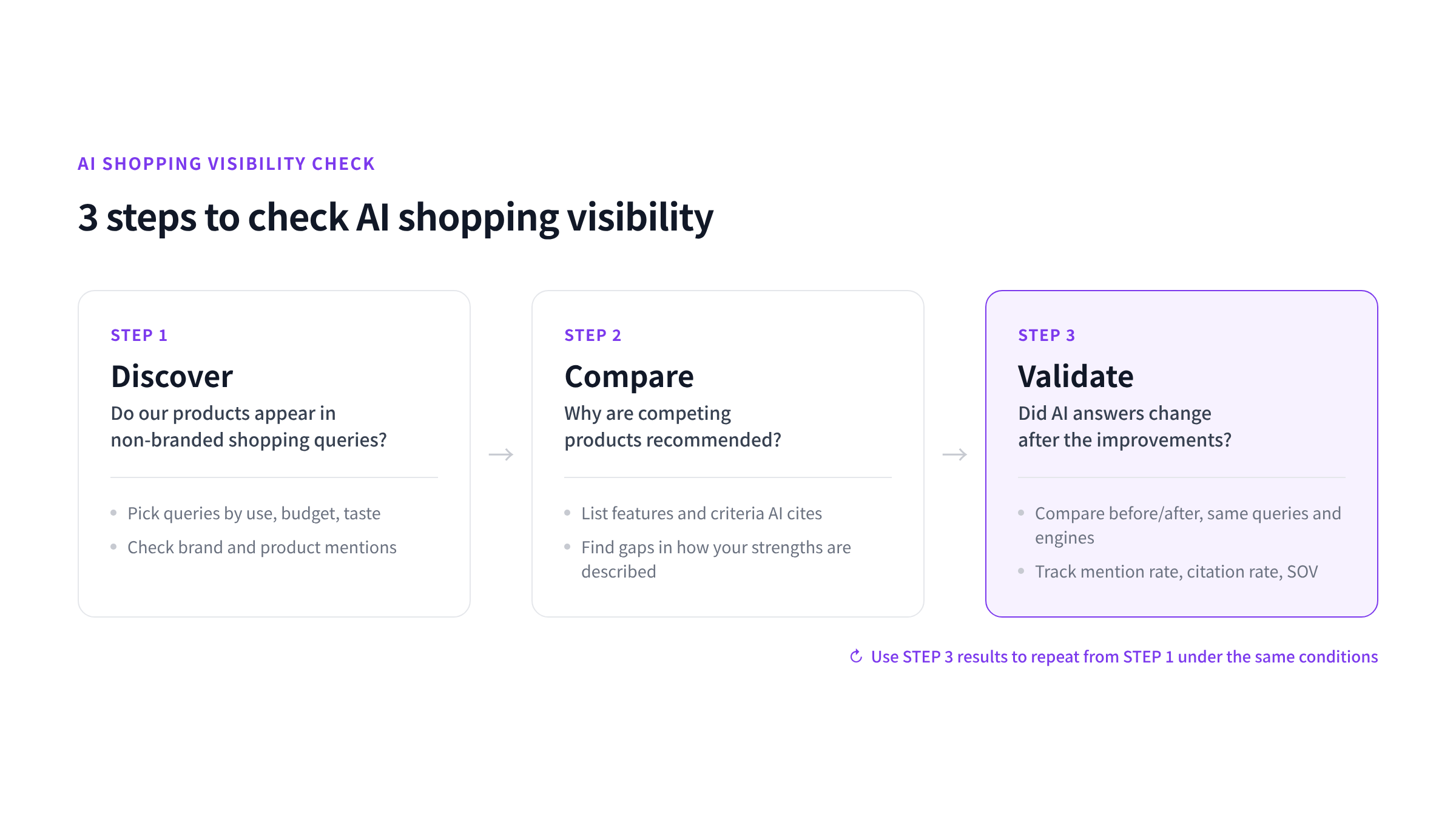
Pick real shopping questions that don't include your brand name and check whether your products appear.
Within the same category, AI recommendations can change with use case, budget, and preference. Check branded queries, but also check the questions from shoppers who haven't chosen a brand yet.
If your product doesn't appear, look at what the AI cites when it recommends competitors. Trace the features, usage settings, prices, and customer ratings it mentions back to specific information on competitor pages, and you'll see where to improve.
The point isn't to copy competitor wording. It's to check whether the strengths your product really has are explained well enough online. Suppose your moisturizer's selling point is its light texture, but the product page only talks about "rich hydration." You can add clearer information about how it feels on the skin.
After updating product pages and product information, compare results before and after using the same questions and the same AI engines.
AI answers can vary with timing, personalization, search results, and model updates. Don't draw conclusions from one or two tests. Keep tracking results under the same conditions.
As agentic commerce develops, brands have to manage more than page design and search rankings. They also need to know the conditions under which AI finds their products and the reasons it gives for recommending them.
VIVI by BubbleShare helps you check and improve that visibility. In VIVI Insight, you can see your brand's Mention Rate, Citation Rate, and Share of Voice in AI answers, organized by the questions customers ask.
See which questions surface your brand, which competitors appear alongside you, and whether your pages are cited as the basis for recommendations. That tells you which content and product information to fix first.
If your product pages carry their main details in large banner images, VIVI PDP Converter can turn the product information in those images into text and HTML. You can check where your brand stands in AI answers today, fill in the missing product information, and track the change against the same baseline.
The rise of AI shopping doesn't mean you have to throw out your online shopping strategy. But the places where shoppers discover products are shifting, and brands should measure how that affects whether their products get found and recommended.
When a customer asks AI for a product recommendation, under what conditions does your product make the list? Answering that question is how you start preparing for agentic commerce.