What Information Does AI Use to Compare Products? What Your Product Detail Pages Need
Learn what product information matters in AI shopping, from pricing and specifications to usage requirements. Explore how to optimize product detail pages and make image-based product information more accessible to AI systems and search engines.
10 min read
by Sooah Lee
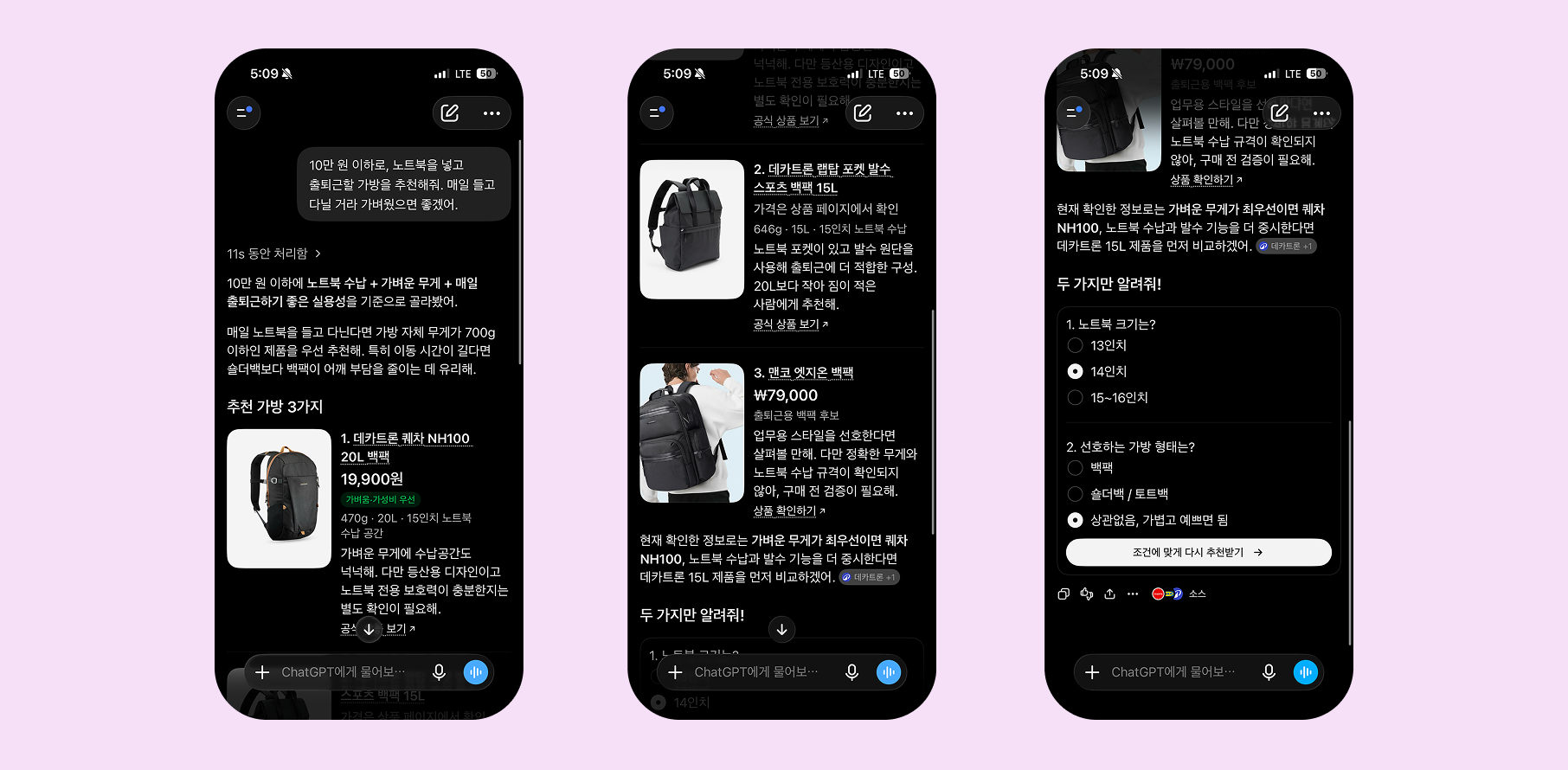
Would your brand's bag make it onto the recommendation list if a customer asked AI this question?
Can you recommend a lightweight commuter bag under 100,000 KRW that fits a laptop? I'll be carrying it every day.
This question contains four purchase criteria: price, storage capacity, weight, and intended use. For AI to compare suitable products, it needs information that addresses each of these criteria. But what if your product detail page only describes the bag as a "lightweight everyday bag" with "plenty of storage space"?
Those descriptions communicate the product's appeal, but they make it difficult to determine how well the bag meets the customer's specific requirements.
As more consumers turn to AI for product discovery, the role of product detail pages is evolving. In March 2026, OpenAI introduced improvements to product discovery in ChatGPT, highlighting an experience that helps users find products based on their budgets, preferences, and constraints, while comparing prices, reviews, and key features in one place.
For marketers, this means going beyond presenting product benefits in a compelling way. They also need to consider whether their product detail pages provide enough information for customers to compare products against their specific requirements.
In this article, we'll explore the information AI uses to discover and compare products, and outline what marketers should review and improve on their product detail pages.
1. In AI Shopping, Customer Requirements Shape Product Comparisons
In traditional online shopping, customers typically move between multiple product detail pages to compare prices, features, and reviews themselves. With AI shopping, they can delegate part of that research process to AI.
Even without knowing the exact product they want, customers can describe their budget, intended use, and preferred features in natural language to discover suitable options.
According to OpenAI's official guidance, ChatGPT considers not only the user's query and conversation context when suggesting products, but also structured information such as pricing and product descriptions, along with external content.
For customers prioritizing affordability, price may be a key comparison factor. For those seeking a particular feature, whether a product supports that feature may carry greater weight.
Let's revisit the commuter bag example.
Customer requirement
Information needed on the product detail page
What the customer wants to know
Under 100,000 KRW
Price by variant, discounts, and shipping conditions
Does the actual purchase price fit my budget?
Laptop storage
Internal compartment dimensions and compatible device sizes
Will my laptop fit?
Lightweight
Product weight and measurement conditions
Is it comfortable enough to carry every day?
Daily commuting
Compartment layout, closure type, materials, and care instructions
Is it suitable for everyday commuting?
Even for the same bag, the information customers need depends on their priorities. Someone focused on affordability needs to compare actual purchase prices, while someone prioritizing portability needs to evaluate weight and storage options.
Descriptions such as "lightweight" or "spacious" alone do not provide enough information to assess specific purchase requirements. Measurable details, such as product weight and compartment dimensions, help customers determine whether a product meets their needs.
In AI shopping, the goal is not simply to list more product benefits. It's to explain those benefits in ways that customers can evaluate against their purchase criteria.
The extent to which individual product attributes influence AI recommendations varies by system and query context. However, providing accurate, specific product information is an area that marketing teams can directly improve.
2. Effective Product Detail Pages Turn Product Benefits Into Comparable Information
What information should a product detail page include?
Rather than adding as many specifications as possible, the priority should be connecting product features to the criteria customers actually care about.
For example, a description of "water-resistant material" becomes more useful when it also explains the material's characteristics and the conditions under which it should be used. By clarifying both suitable use cases and limitations, brands can give customers a more reliable basis for evaluating the product.
Product detail page information can be reviewed across four categories.
Information category
What to include
What to check
Product identification
Product name, model number, variants, included components
Is it clear which product and variant the information describes?
Does the information reflect current purchase conditions?
One important point is that usage requirements and limitations are just as relevant to purchase decisions as product benefits.
Consider a bag advertised as "fits a 15-inch laptop." If the product page also provides the compartment's internal dimensions and compatibility range, customers can assess whether their specific device will fit. After all, two 15-inch laptops may have different physical dimensions.
Specific measurements and conditions clarify how a product can be used while providing objective support for the benefits a brand wants to communicate.
A description such as "a lightweight, practical commuter bag" becomes more credible when supported by actual weight, compartment dimensions, and material specifications.
When reviewing a product detail page, ask one question about each major product benefit:
Does this product benefit have supporting information that customers can verify and use to compare alternatives?
Using this question as a guide helps identify which information is already sufficient and which details need improvement.
3. Even When Product Information Is Available, It Needs to Be Accessible Beyond Images
Once you've confirmed that the necessary product information exists, the next step is to examine how that information is presented.
In Korean ecommerce, it's common to present product features and benefits through long, image-based product detail pages. Combining product photography, marketing copy, and specification tables into a single visual design can make detailed information easy for shoppers to understand.
However, information that's easy for people to see isn't necessarily equally accessible to search systems.
In its official guidance for AI Overviews and AI Mode, Google recommends making important content available in text form and ensuring that structured data matches the content visible on the page.
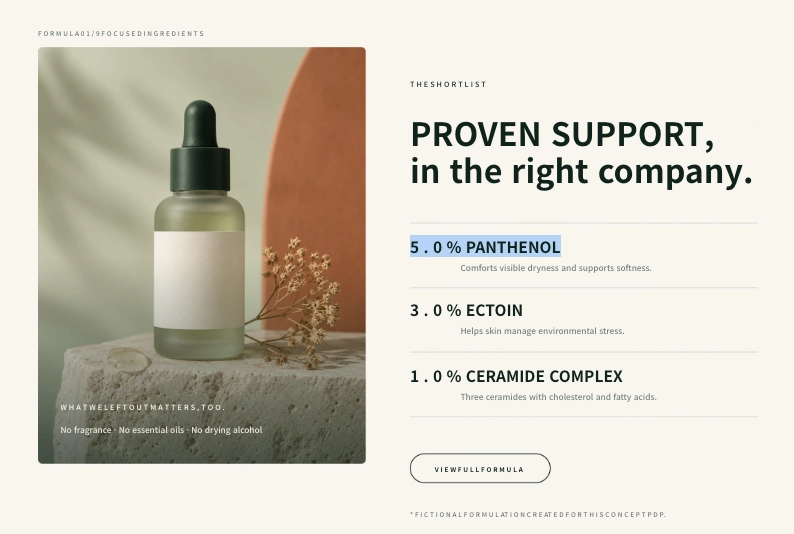
For example, a product detail image may contain important information about weight, compartment dimensions, and material care instructions. Customers can zoom in to read these details.
But if that information appears only within the image and isn't available as page text, search systems may face limitations in consistently retrieving and using it.
This creates two distinct scenarios for product detail page optimization.
Product detail page condition
Recommended improvement
Information needed to address customer purchase criteria is missing
Verify the product specifications and add the missing details
The necessary information exists but appears only in product images
Extract the information and make it available as accessible text
The first scenario requires adding missing product information. The second involves converting existing information into a format that search systems can read.
The second task can become particularly demanding when managing large product catalogs. Extracting information from completed product images and organizing specifications, usage instructions, and other details into HTML involves substantial repetitive work.
How to Structure Product Information Without Redesigning Your Existing Pages: PDP Converter
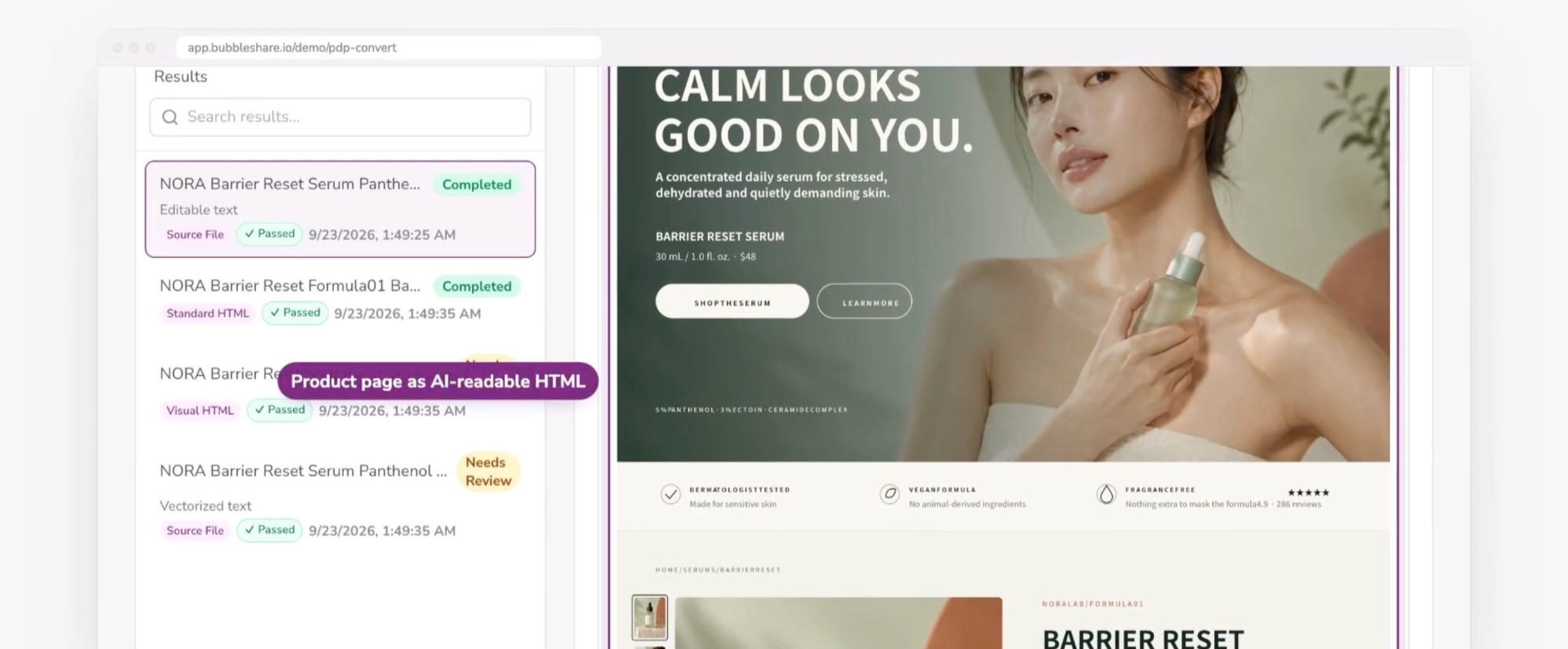
One tool designed to support this process is BubbleShare's PDP Converter.
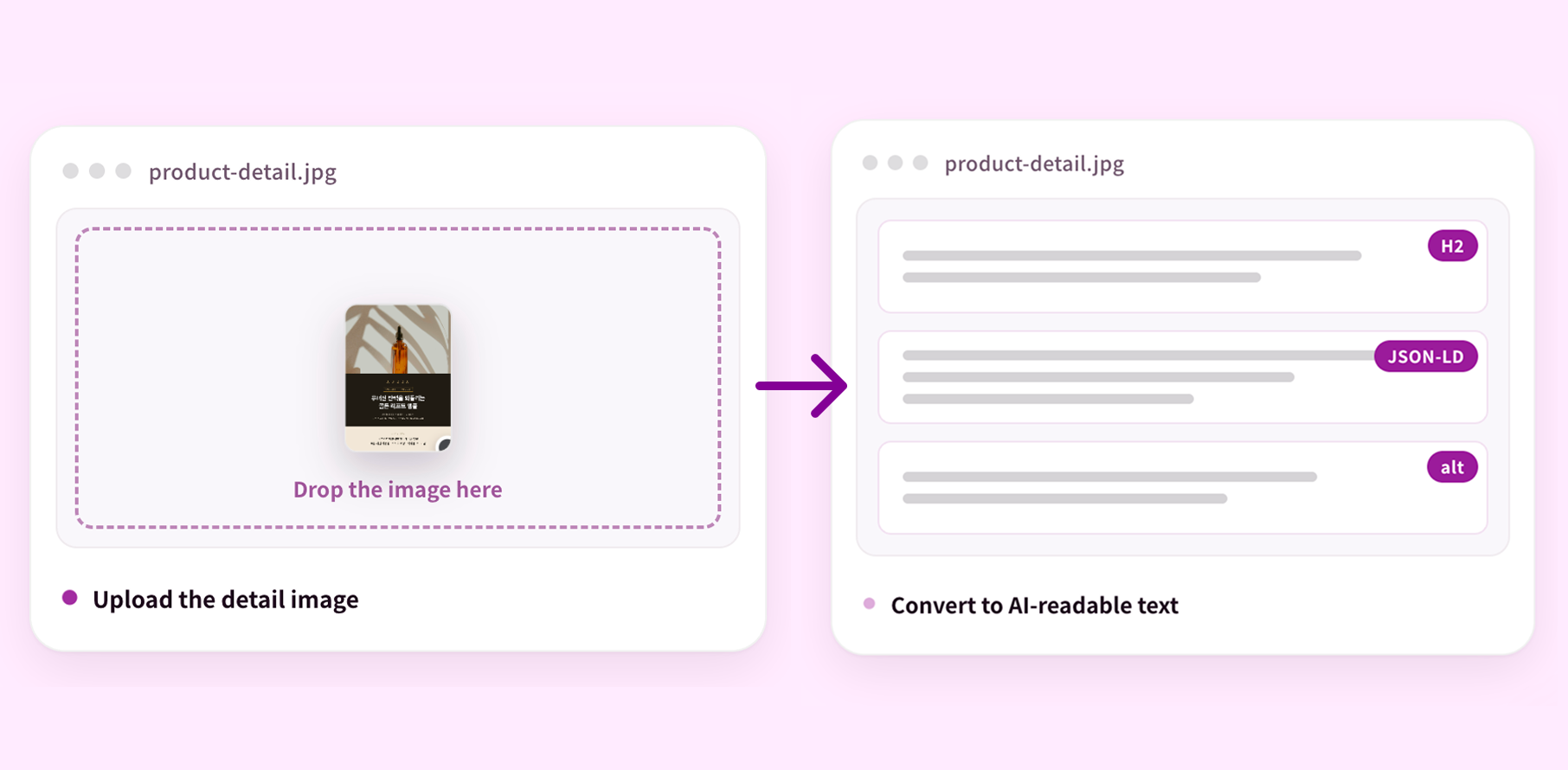
PDP Converter extracts information from product detail images or product URLs and converts it into structured text that AI systems and search engines can access.
Rather than simply extracting text from an image, it organizes product information by meaning and presents it in a format that search systems can more easily interpret.
Specifically, PDP Converter divides long product detail images into meaningful sections, such as ingredients, benefits, usage instructions, and reviews. It then inserts semantic HTML text and image alternative text (alt text) between the images.
The tool also supports generating structured product data in JSON-LD format.
For example, if an existing bag product detail image includes weight, compartment dimensions, and material information, PDP Converter can make each of these details available as separately organized text.
This helps ensure that product information relevant to customer purchase criteria isn't confined to visual designs.
PDP Converter feature
Value for marketing teams
Product information extraction and text conversion
Make specifications and descriptions previously available only in images usable as text
Meaning-based image segmentation and semantic HTML
Organize product features and usage requirements so search systems can interpret them
Structured data and image alt text
Clarify product information and its context while improving accessibility
Preservation of existing product page design
Improve information structure without recreating existing visual assets
Output formats for different marketplaces
Adapt the results for platforms such as Naver Store, Coupang, and Olive Young
The core value of PDP Converter is its ability to preserve an existing product detail page's visual design while reorganizing its information into a structure that's more accessible to search systems.
Marketing teams can extend the value of their existing content assets without rebuilding product detail pages from scratch.
By making product specifications and usage requirements available as structured text, brands can build a stronger foundation for adapting their product pages to AI search environments.
If you're looking to make the information in your existing product detail pages more accessible to AI systems and search engines, explore PDP Converter.
Start Optimizing Product Detail Pages for AI Shopping With the Information You Already Have
In AI shopping, the effectiveness of a product detail page depends not only on how compellingly it presents a product, but also on how clearly and accessibly it provides the information customers need to evaluate their options.
Based on the points covered in this article, ask these three questions when reviewing your product detail pages.
Does the page provide enough information for customers to compare products?
Check whether customers can find the prices, specifications, usage requirements, and other details that matter to their purchase decisions.
Are product benefits supported by specific evidence?
Review whether claims such as "lightweight," "convenient," or "high-performance" are backed by measurable specifications and clear usage conditions.
Is that information accessible to AI systems and search engines?
If important details exist only within images, consider whether they can also be provided as text and appropriate structured data.
Answering these questions helps determine whether you need to create new content, improve existing product information, or make better use of information you already have.
An effective AI shopping content strategy starts with providing accurate, accessible information that addresses the criteria customers use to compare products.
If your product detail pages already do a good job communicating product value to customers, the next step is to ensure that AI systems and search engines can access and use that information as well.
BubbleShare's PDP Converter supports this process by converting product information embedded in images into structured text while preserving the original visual design.