GEO Marketing in 3 Steps: From AI Search Visibility to Content Improvement
Start GEO marketing by measuring AI search visibility. Use VIVI to compare brand mentions, citations, and share of voice, then identify content improvement opportunities.
Start GEO marketing by measuring AI search visibility. Use VIVI to compare brand mentions, citations, and share of voice, then identify content improvement opportunities.
Start GEO marketing by measuring AI search visibility. Use VIVI to compare brand mentions, citations, and share of voice, then identify content improvement opportunities.
Start GEO marketing by measuring AI search visibility. Use VIVI to compare brand mentions, citations, and share of voice, then identify content improvement opportunities.
Start GEO marketing by measuring AI search visibility. Use VIVI to compare brand mentions, citations, and share of voice, then identify content improvement opportunities.
When customers ask ChatGPT or Gemini for product recommendations, how often does your brand appear? How large is your share of mentions compared with competitors? And when AI does mention your brand, what strengths does it associate with it?
As AI search becomes a product discovery channel, marketers need data to answer these questions. Just as they monitor performance in traditional search, they need to measure brand visibility in AI search, compare it with competitors, and determine which content needs improvement.
BubbleShare’s VIVI is a GEO solution that measures brand mention rates, citation rates, and share of voice across major AI search engines, while also allowing marketers to analyze AI responses and cited sources by prompt.
In this article, we’ll walk through three ways to use VIVI: ① assess your brand’s AI search visibility → ② analyze differences from competitors → ③ identify content improvement opportunities through cited sources.
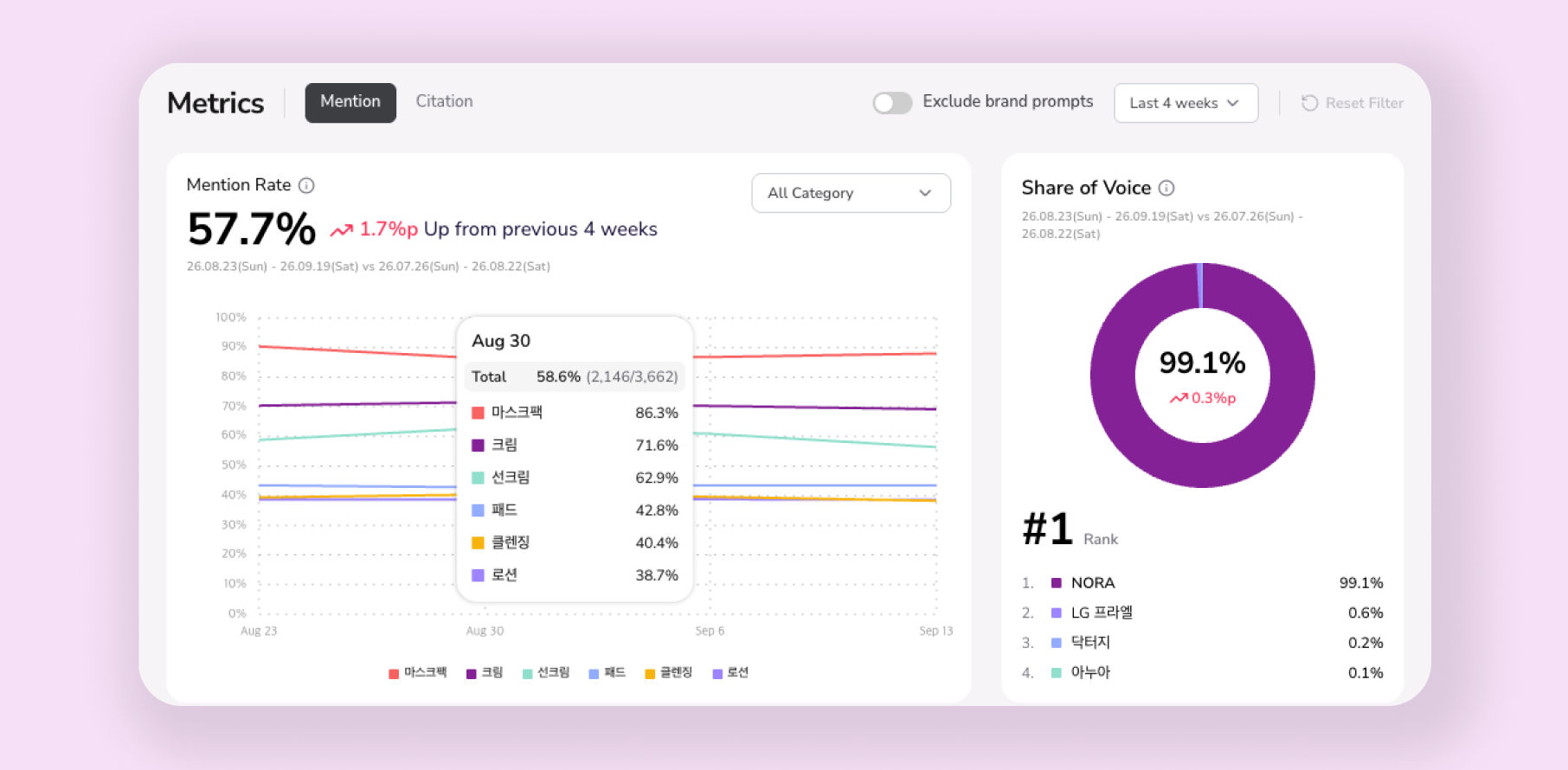
To manage AI search performance, you first need to understand how often your brand appears in AI-generated responses. VIVI collects responses from major AI search channels, including ChatGPT, Gemini, Perplexity, Google AI Overview, and NAVER AI Briefing, and measures brand mentions and citations.
The dashboard provides three key metrics for understanding brand visibility.
| Metric | Meaning | What It Tells You |
|---|---|---|
| Mention Rate | The percentage of collected AI responses that mention your brand | How often does our brand appear? |
| Citation Rate | The percentage of collected AI responses that cite your own domain or content | How often are our website and content used as sources? |
| Share of Voice | Your brand’s share of mentions among the competitor brands being tracked | Where do we stand compared with competitors? |
Looking at these three metrics together helps distinguish brand mentions from citations of your own content. For example, if your Mention Rate is high but your Citation Rate is low, your brand may appear frequently in AI responses while your own content is cited relatively less often.
If a competitor has a higher Share of Voice, the next step is not simply to note the numerical difference. You also need to examine which customer questions are driving that competitor’s stronger visibility.
Once you understand your overall Mention Rate and Share of Voice, the next step is to examine the specific customer questions where AI introduces your brand and your competitors.
For example, consumers looking for skincare products may ask different questions depending on their skin concerns and purchase criteria.
“Recommend a moisturizer for sensitive skin.”
“What are some good ceramide creams for dry skin?”
“Recommend a lightweight moisturizer for oily skin that doesn’t feel sticky.”
“What are some affordable moisturizers I can buy at Olive Young?”
All of these questions are about moisturizers, but the criteria customers care about are different. One question focuses on skin type and ingredients, while another focuses on texture, price, or purchase channel.
A high overall Mention Rate does not mean the same brand will be recommended for every customer question. This is why it is important to see how your brand’s visibility changes depending on different purchase criteria.
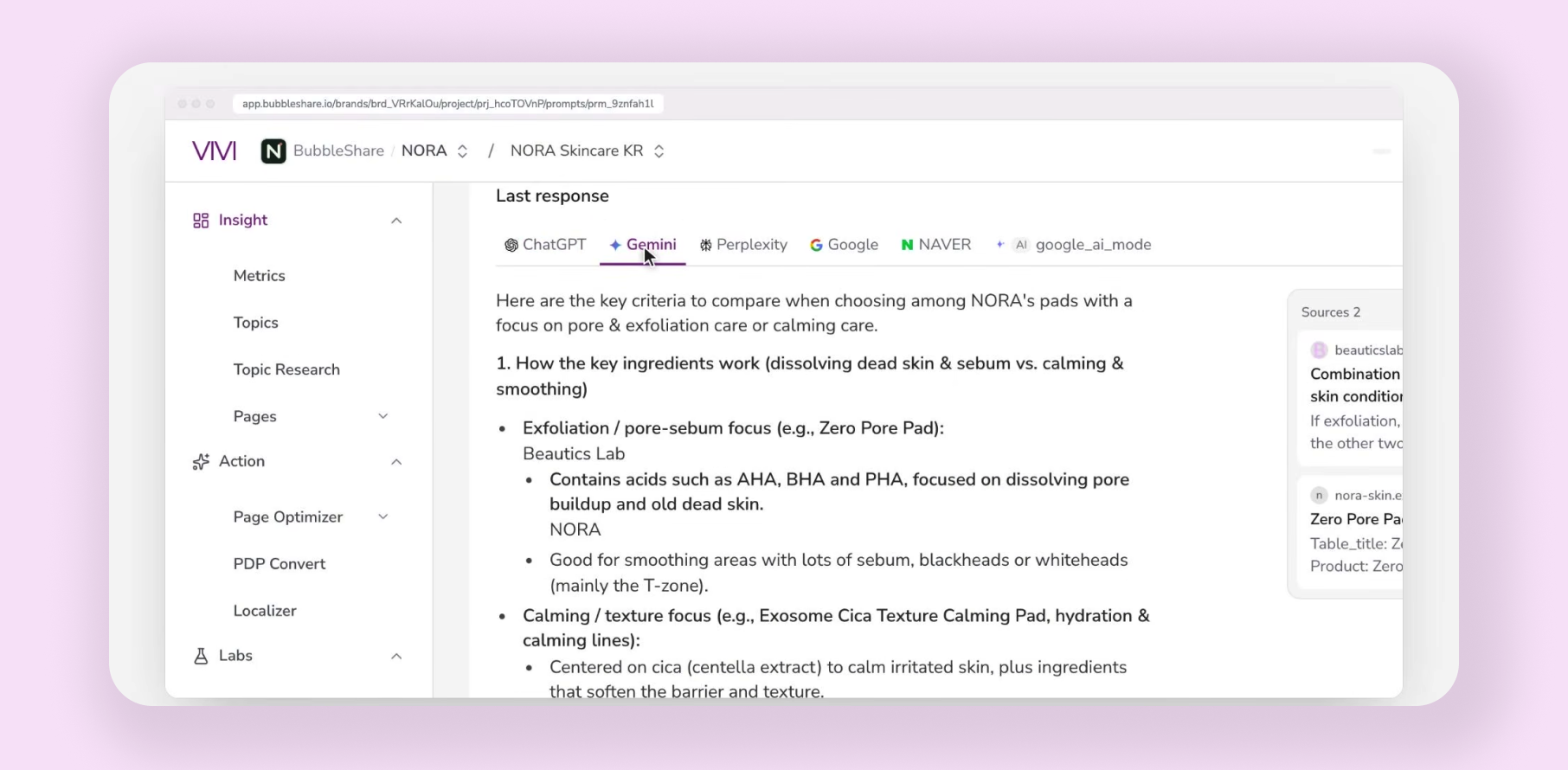
In VIVI, you can review AI responses for each tracked prompt and compare how your brand and competitors are mentioned in each question. This allows you to look beyond overall mention frequency and identify which purchase criteria create differences between you and your competitors.
It is especially useful to review responses from the following three perspectives.
| Analysis Area | What to Look For |
|---|---|
| Brand presence | Which questions mention competitors but not your brand? |
| Competitors’ key strengths | What ingredients, product experiences, or price points does AI associate with competitors? |
| Your positioning | How are the product strengths your brand emphasizes reflected in AI responses? |
For example, if a competitor’s product repeatedly appears in responses to “moisturizer for sensitive skin,” you can examine which ingredients or product characteristics AI uses when describing it.
If a competitor is described as “a moisturizing cream containing ceramides,” you can compare whether your product has similar characteristics and whether those characteristics are reflected in AI responses. Conversely, if your brand emphasizes a lightweight texture but that strength rarely appears in relevant responses, that is another area worth examining.
By narrowing the analysis down to individual prompts, you can identify the customer questions where your brand is underrepresented and understand which strengths AI associates with your competitors.
So how can you determine what information your own content should improve to close the gap with competitors? One useful source of insight is the content cited in AI responses.
VIVI allows you to review the URLs cited in individual AI responses. By examining which official pages and external content are cited when a competitor’s product appears, you can compare those sources with your own content and identify information that may need to be strengthened.
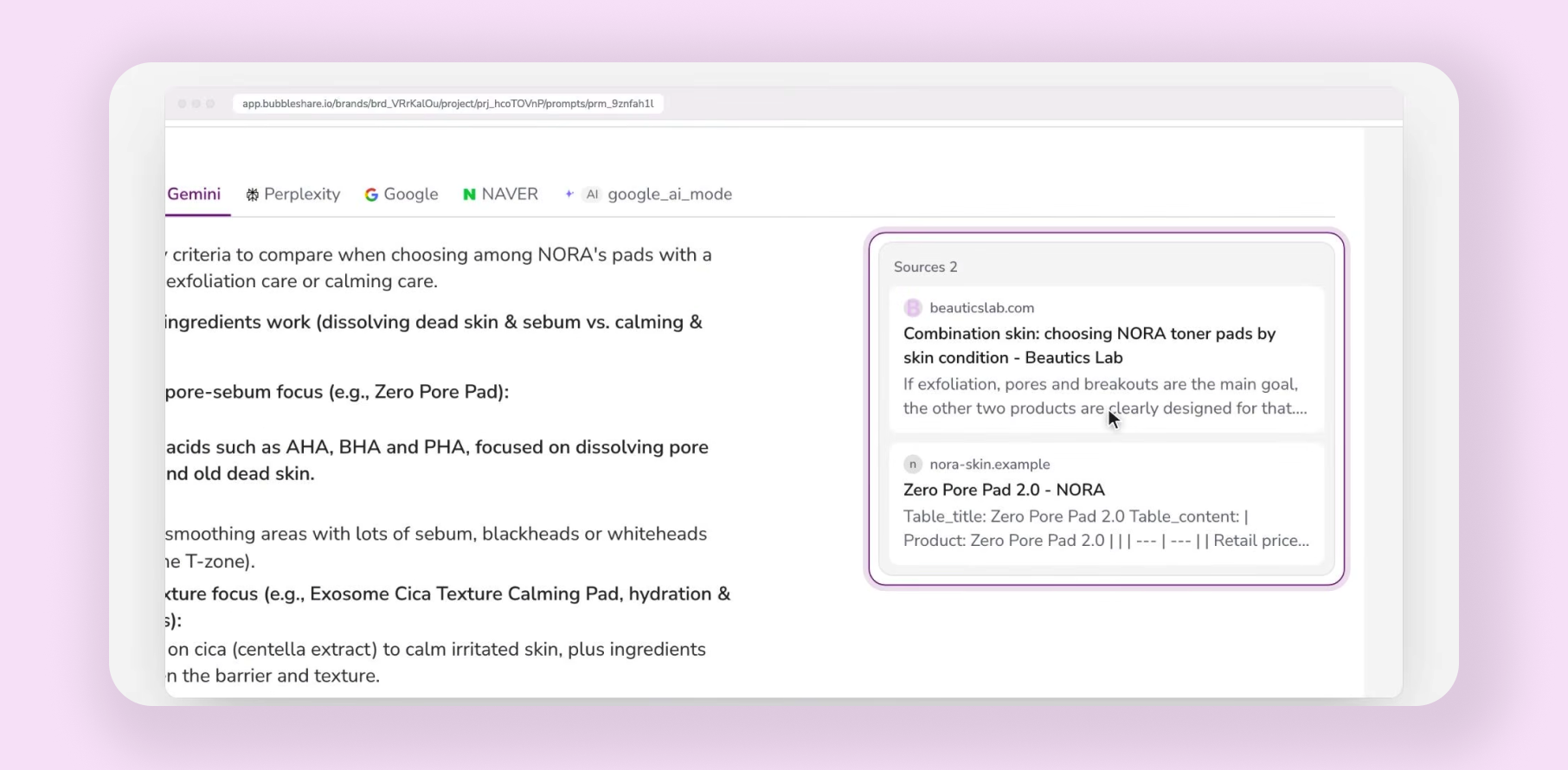
Let’s return to the earlier example: “a moisturizer that works well for sensitive skin.” Even when a competitor’s product is recommended, what you should review depends on the type of source being cited. On an official product page, you might focus on how the product’s ingredients and intended users are described. In third-party comparison content, you might instead examine the criteria used to compare products.
| Cited Source | What to Review | What to Check in Your Own Content |
|---|---|---|
| Competitor’s official product page | What information is provided about skin type, key ingredients, texture, and other product characteristics? | Does your content provide enough information for the purchase criteria customers care about? |
| External comparison content | Which skin concerns and product characteristics are used as comparison criteria? | Are your differentiators explained with specific supporting evidence? |
| Your own official product page | Which pages are cited, and which information appears in AI responses? | Are your key product strengths being communicated clearly enough? |
Combining source analysis with the prompt-level mention data from the previous step helps you identify more specifically which information is missing from your content relative to the purchase criteria customers use.
From there, you can define improvement tasks such as:
Add information about intended users: If your brand is mentioned less frequently in questions related to certain skin types, add clearer descriptions of who the product is intended for and strengthen the connection between the product and customers’ specific skin concerns.
Make product differentiators more specific: If AI describes a competitor’s key ingredients and texture but does not adequately explain your product’s strengths, clarify those differentiators using verified product characteristics and supporting evidence.
Expand content around customer questions: If skin-type-specific comparison content appears frequently among cited sources, consider creating relevant buying guides or FAQs.
By using VIVI’s AI response and citation data together, you can identify which information and content should be improved based on actual customer questions and your position relative to competitors.
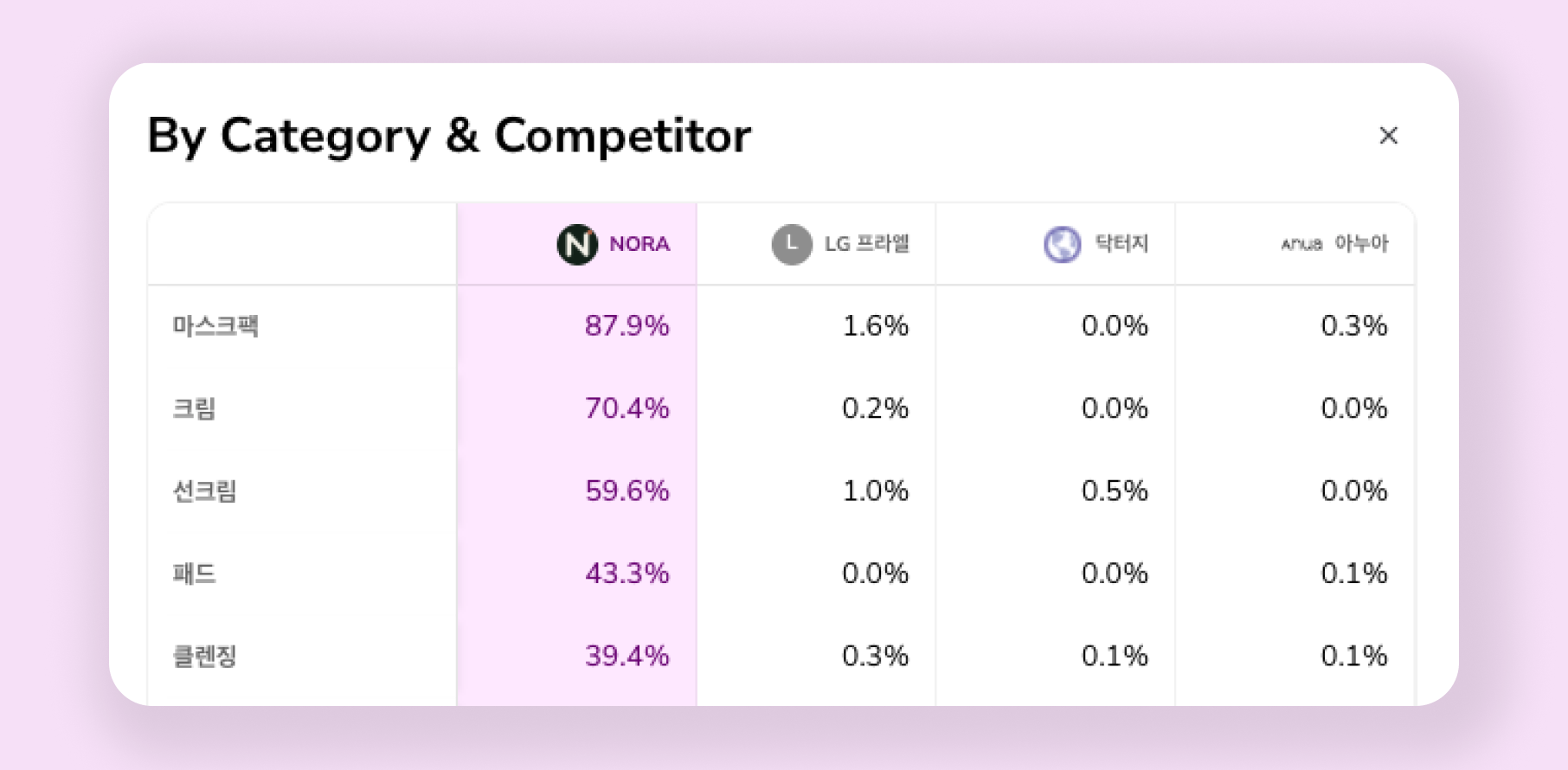
Managing your brand’s presence in AI search requires more than measuring current performance. You also need to understand which customer questions reveal gaps between your brand and competitors, and then strengthen the information related to those questions.
The VIVI workflow covered in this article can be summarized in three steps.
Assess visibility: Measure your brand’s AI search performance using Mention Rate, Citation Rate, and Share of Voice.
Compare competitors: Review AI responses by prompt to identify differences in brand mentions and the key strengths associated with your brand and competitors.
Identify content improvement opportunities: Analyze the sources cited by AI and determine which information and pages should be improved first.
This allows marketers to connect their brand’s current AI search visibility with specific customer questions and actionable content improvements. After making changes, you can also remeasure the same prompts and citation patterns to observe how the results change over time.
Which questions does AI associate with your brand, and what strengths does it use to describe you?
Use VIVI to review your brand’s mentions, citations, and Share of Voice against competitors, and identify your next content improvement opportunity.