How to Get Your Blog Featured in ChatGPT Search: Essential GEO Optimization Steps
What does it take for your blog to be discovered and cited in ChatGPT Search? Explore the essentials of GEO, from AI crawler settings and content structure to optimization best practices and performance measurement.
How to Get Your Blog Featured in ChatGPT Search: Essential GEO Optimization Steps
What does it take for your blog to be discovered and cited in ChatGPT Search? Explore the essentials of GEO, from AI crawler settings and content structure to optimization best practices and performance measurement.
How to Get Your Blog Featured in ChatGPT Search: Essential GEO Optimization Steps
What does it take for your blog to be discovered and cited in ChatGPT Search? Explore the essentials of GEO, from AI crawler settings and content structure to optimization best practices and performance measurement.
How to Get Your Blog Featured in ChatGPT Search: Essential GEO Optimization Steps
What does it take for your blog to be discovered and cited in ChatGPT Search? Explore the essentials of GEO, from AI crawler settings and content structure to optimization best practices and performance measurement.
14 min read
Why GEO Matters: Beyond Search Rankings and into AI Answers
Traditionally, marketers have measured content performance through keyword rankings and search clicks. With AI search, however, users can get the information they need directly from AI-generated answers and explore the sources cited alongside them. This means marketers need to look beyond traditional search visibility and understand how their content is being used in AI responses.
Generative Engine Optimization (GEO) involves improving a website's accessibility, information structure, content accuracy, and sourcing so that generative AI search systems can more easily discover and use its content. This starts with making key answers easy to find, providing relevant context and supporting evidence, and ensuring that page titles and metadata accurately describe the content.
But before you start optimizing, how can you find out how visible your blog already is in AI search?
Check Your Brand's AI Search Visibility with VIVI Insight
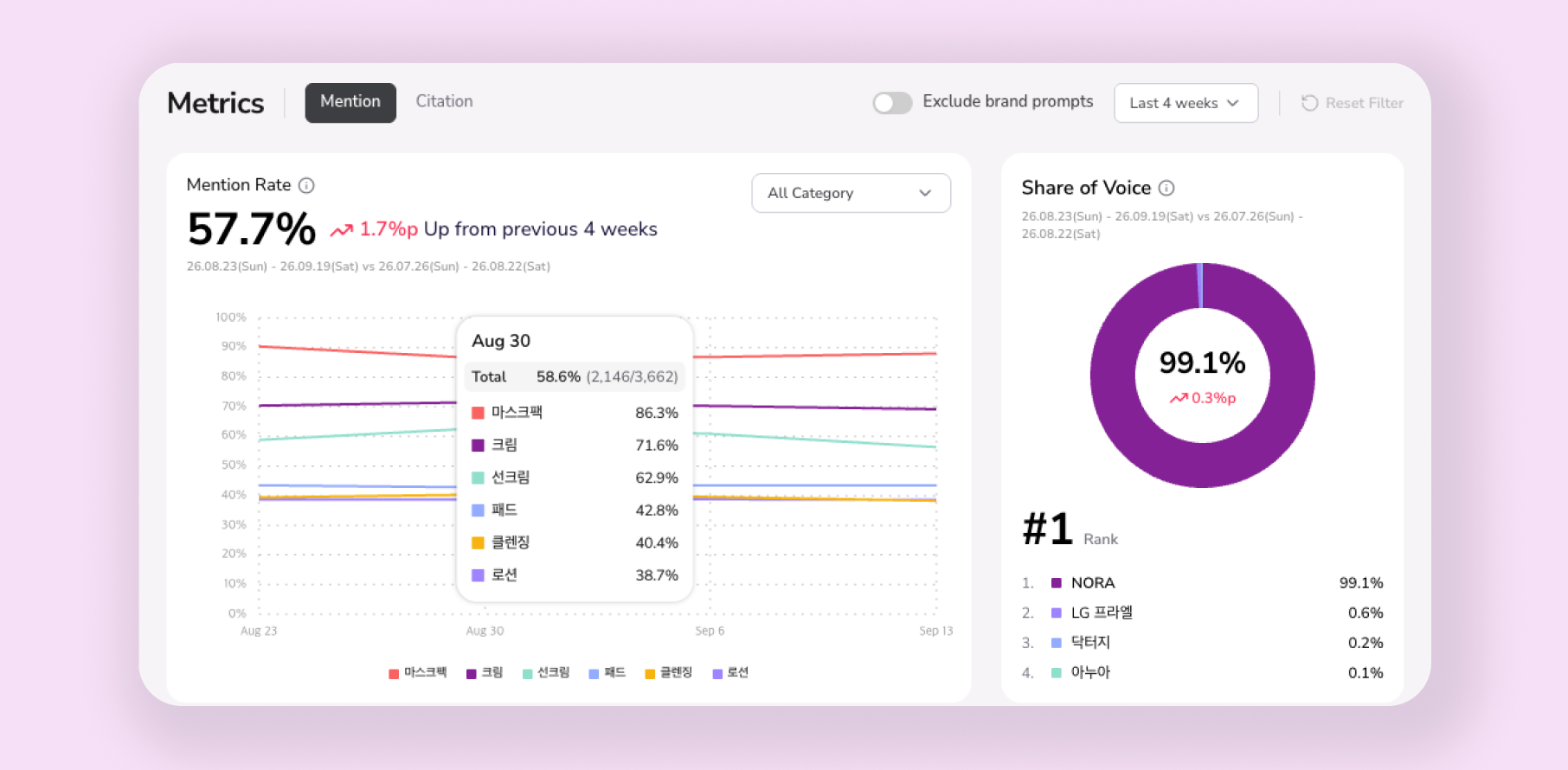
With BubbleShare's VIVI Insight, you can analyze how often your brand appears in AI-generated answers to important customer questions and which URLs from your website are cited as sources.
Before starting your GEO optimization efforts, assess your brand's current AI search visibility and identify which questions and content areas need the most attention.
If your website or products don't appear when someone asks ChatGPT a question related to your brand, where should you start?
First, it helps to understand how ChatGPT discovers and uses information from the web. Rather than simply displaying a list of search results, ChatGPT can search the web when needed and provide links to supporting sources. It draws on multiple channels, including third-party search providers and OpenAI's own web crawlers. As a result, your content may be discovered in ChatGPT Search even if it doesn't rank at the top of traditional search results.
OpenAI uses different crawlers for different purposes. OAI-SearchBot is used to surface websites in ChatGPT Search, while GPTBot collects content that may be used to train AI models. Website owners can manage access permissions for these crawlers separately.
If you want your blog to appear in ChatGPT Search, start by checking whether OAI-SearchBot is allowed to access your site through its robots.txt file and server security settings. However, allowing crawler access doesn't guarantee that your content will be cited. Making your content accessible to AI systems and checking whether it actually appears in relevant answers are both important parts of GEO.
1. Make Sure AI Crawlers Can Access Your Blog
robots.txt: Allow Access for ChatGPT Search Crawlers
The robots.txt file communicates crawler access rules for different paths on your website, following the RFC 9309 standard. If you want your publicly available content to appear in ChatGPT Search, make sure OAI-SearchBot isn't blocked. GPTBot, which is used for model training purposes, can be allowed or blocked separately.
Start with the following checks:
Is OAI-SearchBot allowed to access your main blog pages?
Could your server or CDN security settings be blocking crawler requests?
Have you defined access policies for other AI crawlers, such as GPTBot, ClaudeBot, and PerplexityBot?
If you offer paid content, have you clearly separated public and restricted areas?
You can typically review your site's crawler policies at yourdomain.com/robots.txt. You should also check whether any server-level or CDN restrictions are blocking access. Keep in mind that robots.txt communicates crawler policies; it isn't an authentication mechanism. Private content requires separate access controls.
XML Sitemaps: Help Search Engines Discover Important Blog URLs
Keep your XML sitemap updated so search engines can discover newly published and revised blog posts. Include canonical URLs, update the lastmod value when content has materially changed, and exclude deleted URLs or unnecessary duplicate pages.
You can submit and manage sitemaps through Google Search Console and Bing Webmaster Tools. However, sitemap submission helps those search engines discover your URLs. It isn't a way to request citations directly from ChatGPT.
RSS/Atom Feeds and URL Management
If your blog supports RSS or Atom feeds, you can use them to distribute new posts and content updates. Keep URLs as stable as possible, specify appropriate canonical URLs for duplicate pages, and avoid unnecessary query parameters that create multiple URLs for the same content.
2. Structure Your Content for Search Systems
Use Article/BlogPosting and Organization Structured Data
Structured data helps search systems understand information about a webpage. For blog posts, you can use Article or BlogPosting structured data, while Organization structured data can describe official information about your company.
Make sure the following properties match the information displayed on the page:
Title (headline)
Author (author)
Publication date (datePublished)
Modification date (dateModified)
Featured image (image)
Publisher (publisher)
Structured data provides context about your page. Whether that page is actually cited in an AI-generated answer needs to be evaluated separately.
Add FAQs That Answer Real Reader Questions
An FAQ section can be useful when readers have additional questions related to your article. However, there's no need to add a fixed number of questions to every blog post. Focus on questions your audience actually asks and provide information that helps answer them.
Make Key Answers Easy to Find
When writing content, consider answering the reader's main question early in the article, then expanding on the details. Use H2 and H3 headings to organize topics, and tables or lists to make definitions, step-by-step instructions, and comparisons easier to follow.
For example, if you're introducing several GEO optimization methods, you could use a table to compare their purposes and key checks. This helps readers see what needs to be done and find the relevant information more easily. The goal isn't to follow a rigid writing format, but to present the information your audience needs in a clear, accessible way.
Review Website Accessibility and Performance
Use semantic HTML and provide alternative text (alt) for important images. Where needed, ARIA attributes can further improve accessibility.
It's also worth reviewing image sizes, page loading speed, and Core Web Vitals. These improvements help make your website more accessible and easier to use.
Optimize Your Content for AI Search with Page Optimizer
Once you've reviewed crawler access and structured data, the next step is identifying which existing blog content should be improved first.
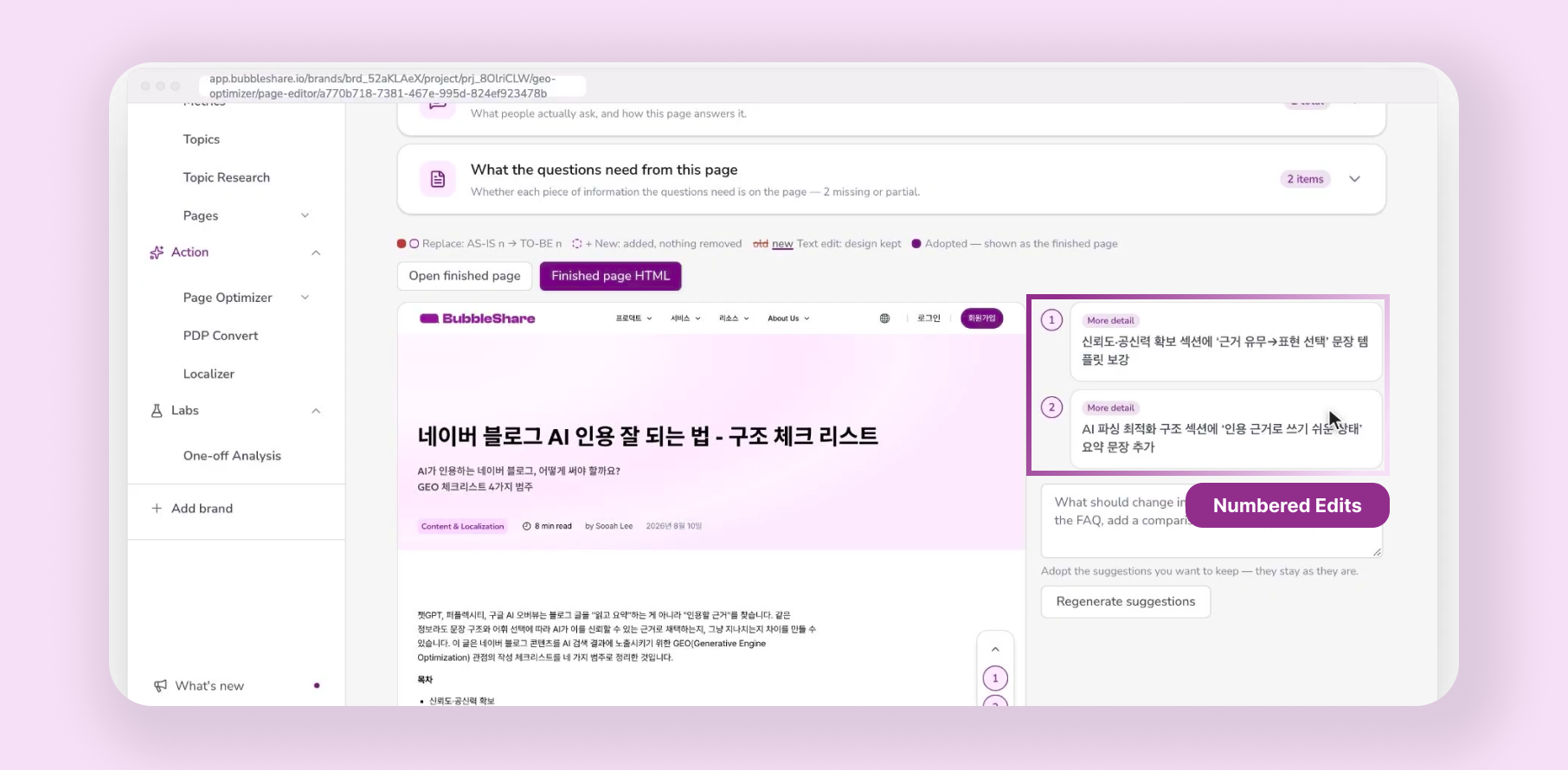
BubbleShare's Page Optimizer identifies pages and topics with low citation visibility in AI search and recommends optimization priorities. It can also generate improvements for existing pages or drafts for new content, helping turn analysis into actionable content optimization.
If you're unsure which blog posts to improve first, explore how Page Optimizer can help.
An author profile that includes relevant experience, areas of expertise, and professional background helps readers understand who's behind the content.
Link blog posts to their authors' profile pages and make sure structured data accurately identifies the author. While E-E-A-T isn't an official AI citation scoring system, it's a useful framework for assessing experience, expertise, authoritativeness, and trustworthiness.
Support Important Claims with Verifiable Sources
When presenting key facts or research findings, link to reliable sources such as official documentation, industry reports, and academic publications. Place references close to the claims they support so readers can easily verify the information.
Rather than aiming for a certain number of external links, focus on whether each source supports the claim you're making.
Keep Publication and Modification Dates Accurate
The datePublished and dateModified values should reflect when content was actually published or revised. Topics that change frequently, such as AI search features and platform policies, need regular reviews.
Rather than simply updating the date, check the content itself and revise any information that's no longer accurate.
Clearly Separate Public and Paid Content
If your website offers subscription-based content, clearly distinguish between publicly available sections and restricted material. Google's structured data guidance for paywalled content may also be relevant, depending on your implementation.
Keep in mind that structured data and actual access controls need to be managed separately.
4. Create GEO Content Around Real Customer Questions
Use a Flexible Blog Writing Framework
The following structure can serve as a starting point for your articles:
A title that reflects the user's question
A concise summary that answers the main question
Definitions of relevant concepts and terminology
Step-by-step instructions or a practical checklist
Criteria for comparing alternatives
Additional questions and answers that support the main content
References for important claims
You don't need to follow this exact structure for every post. Comparison articles may need more detailed evaluation criteria, while practical guides benefit from clear, step-by-step instructions.
Start with Questions Your Customers Actually Ask
Use keyword research tools, related search questions, and customer inquiries to understand how people describe their problems. For example, an article explaining the general concept of "GEO optimization" may take a different approach from one answering, "How can I get my blog to appear in ChatGPT Search?"
The more specific the customer question, the easier it becomes to identify what information your content should provide. Start with a direct answer, then add relevant context, conditions, and examples.
Use Accurate and Consistent Technical Terminology
Keep company names, product names, standards, and framework terminology accurate and consistent. For example, an article explaining robots.txt can reference RFC 9309 so readers can verify the underlying standard.
Use Current Evidence for Fast-Changing Topics
When covering topics such as AI search features or zero-click search, check when your sources were published and what period their findings cover. Avoid presenting observations from a particular market or time period as universal behavior across all AI search services.
5. Account for Differences Between AI Search Services
Google AI Overviews and AI Mode
Google states that its existing SEO best practices also apply to AI-powered search experiences, including AI Overviews and AI Mode. There's no special GEO markup required specifically for these features.
Continue following Google's official guidance on content quality, crawlability, structured data accuracy, and search performance.
Bing Search Configuration
Bing Webmaster Guidelines provide recommendations for managing sitemaps, internal links, crawling policies, and content quality. However, being indexed by Bing doesn't automatically mean your content will be cited by ChatGPT.
Treat Bing indexing and actual citations in ChatGPT Search as separate things to evaluate.
How Should You Think About "ChatGPT Indexing"?
Content discovery and citation in ChatGPT Search work differently from checking the indexing status of an individual URL in Google Search Console.
For practical GEO work, it helps to separate two questions:
Technical accessibility: Can AI search systems access your content?
Actual AI visibility: Does your brand or blog appear in AI-generated answers to relevant customer questions?
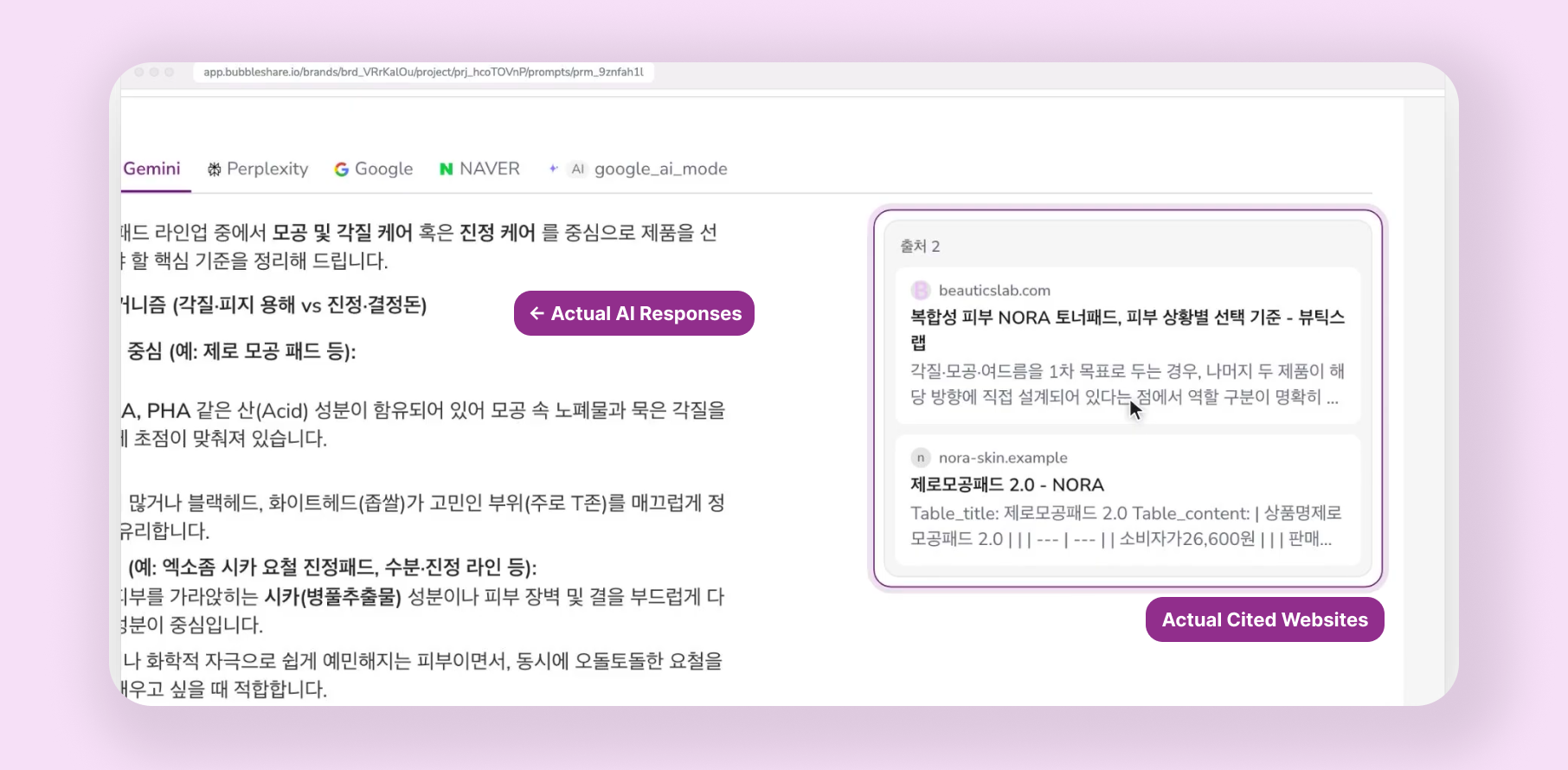
The first involves reviewing crawler settings and website structure. The second requires analyzing actual AI responses and their cited sources.
6. How Should You Measure GEO Performance?
Once you've reviewed technical settings and optimized your content, the next step is to measure the results. The key is to distinguish traditional search performance from visibility within AI-generated answers.
What Google Search Console and GA4 Can Tell You
Google Search Console and Bing Webmaster Tools help you monitor indexing status, search impressions, clicks, sitemap submissions, and crawling issues. Analytics platforms such as GA4 can also help identify website visits referred by recognizable AI search services.
However, these metrics alone don't tell you how often AI systems mention your brand or which blog pages they cite as sources.
Track Brand Mentions and Citations in AI Search
To understand your brand's presence in AI-generated answers, consider the following questions:
Does your brand appear in responses to important customer questions?
Are your blog pages cited as supporting sources?
Which questions feature your competitors more frequently?
Which of your pages receive citations, and which don't?
Different tools help answer different questions.
What you want to know
Tool
Is your blog indexed in Google Search?
Google Search Console
How many impressions and clicks does your content receive in traditional search?
Google Search Console, Bing Webmaster Tools
Is AI search driving identifiable traffic to your website?
GA4 or another analytics platform
Does AI mention your brand?
VIVI Insight
Are your blog URLs cited in AI responses?
VIVI Insight
How does your brand's mention share compare with competitors?
VIVI Insight
It's important to distinguish brand mentions from citations of your own URLs. An AI response may mention your brand without citing your blog. Conversely, your blog may appear as a cited source without the response explicitly mentioning your brand.
Understanding these differences helps you decide whether to review content accessibility, fill information gaps related to customer questions, or examine how competitors are being described.
GEO Metrics Worth Tracking
Consider monitoring the following indicators:
Brand mention rate by query: The percentage of responses to your target customer questions that mention your brand
Citation rate by query: The percentage of responses to your target questions that cite URLs from your website
Share of voice: Your brand's share of mentions relative to competitors
Content optimization status: The structure, sourcing, and update status of key pages
Content freshness: The time elapsed since a page was last meaningfully updated
Rather than evaluating optimization performance solely through fixed numbers of tables, FAQs, or references, consider the results observed in AI-generated answers alongside the quality and completeness of your content.
7. Your Step-by-Step GEO Optimization Checklist
Here's a practical sequence for applying the recommendations covered in this guide.
Step 1. Review Technical Settings
Check whether OAI-SearchBot can access your important pages, and manage training crawler policies separately.
Keep XML sitemaps and lastmod values up to date.
Validate relevant structured data, author details, and publication dates.
Step 2. Improve Your Content
Answer the main question clearly near the beginning of each article.
Address the questions and selection criteria that matter to your audience.
Use tables or lists to make comparisons easier to understand.
Step 3. Strengthen Credibility and Accessibility
Provide verifiable author information and supporting sources.
Make sure important information is accessible to search systems.
Regularly update information on fast-changing topics.
Step 4. Measure AI Visibility and Refine Your Strategy
Review indexing and traffic performance in traditional search.
Track brand mentions and website citations for relevant customer questions.
Compare your visibility with competitors to identify information gaps and opportunities for new content.
Monitor the same questions over time to see how AI responses and citations change after your updates.
ChatGPT Search Optimization: Measure What Happens in AI Answers
To improve your blog's chances of being discovered and used in ChatGPT Search, start by confirming that AI crawlers can access your content. Next, review your content structure, sources, and accuracy, and make sure your articles answer the questions your customers are actually asking.
After making these improvements, you also need to check whether your brand appears in AI-generated answers and which of your blog pages are being cited. These findings can help determine what to improve next.
With BubbleShare's VIVI Insight, you can analyze brand mention rates, website citation rates, and share of voice across major AI search engines. Use these insights to understand which questions feature your brand, identify the content AI systems cite, and prioritize your next content improvements.
Q1. If I follow all these steps, will my blog be indexed by ChatGPT like it is by Google?
Not necessarily. ChatGPT Search doesn't provide the same individual URL indexing verification process as traditional search engines. These steps help establish the conditions for your content to be discovered and used by AI search systems. Whether it is actually cited needs to be checked through AI-generated answers.
Q2. Can I prevent AI systems from using my content?
You can manage crawler access policies based on how you want your content to be used. For example, you can block GPTBot, which is associated with model training, while allowing OAI-SearchBot for ChatGPT Search. If you need to restrict access to the webpage itself, consider separate authentication and access controls.
Q3. Will FAQ structured data make my content appear in Google AI Overviews?
Structured data alone doesn't guarantee visibility in AI search. Google ended support for FAQ rich results in May 2026 and doesn't require special markup for AI Overviews. Rather than adding FAQs simply for search visibility, use them to answer questions your audience genuinely wants to know more about.