AI Search for SaaS: How to Respond to Zero-Click Search with GEO
Learn how SaaS marketers can address declining organic traffic with GEO. Review AI search visibility, track conversions, and optimize content.
Learn how SaaS marketers can address declining organic traffic with GEO. Review AI search visibility, track conversions, and optimize content.
Learn how SaaS marketers can address declining organic traffic with GEO. Review AI search visibility, track conversions, and optimize content.
Learn how SaaS marketers can address declining organic traffic with GEO. Review AI search visibility, track conversions, and optimize content.
Learn how SaaS marketers can address declining organic traffic with GEO. Review AI search visibility, track conversions, and optimize content.
SaaS companies may notice a worrying trend: a decline in organic traffic, even while continuing to invest in content and technical SEO. If rankings for your main keywords haven’t significantly changed, it is worth examining whether the way customers interact with search results has changed.
One factor to consider is zero-click search, where users do not click a link in the search results. They may find an answer on the results page, although the absence of a click does not necessarily mean they have finished looking for information. AI-generated answers can also become part of that journey. However, declining traffic should not automatically be attributed to AI search. Search demand, rankings, indexing, seasonality, and measurement settings also need to be reviewed.
A 2025 analysis by Pew Research Center examined the March 2025 browsing activity of 900 U.S. adults. Users clicked a traditional search result on 8% of Google search visits with an AI summary, compared with 15% of visits without one. This was an observed difference within a specific sample, not a traffic-loss estimate for all SaaS websites or proof that AI summaries caused the difference.
If you’re a SaaS marketer or SEO manager, the task is to understand why clicks are declining while also examining how your brand and content appear in AI search. This article covers the fundamentals of Generative Engine Optimization (GEO), performance measurement, content improvements, and an action plan for putting them into practice.
Zero-click searches are searches that end without the user clicking a result link. They can occur with instant answers, such as definitions and weather information, as well as knowledge panels and featured snippets. Zero-click search is therefore not exclusive to AI search. AI summaries are another form of direct answer.
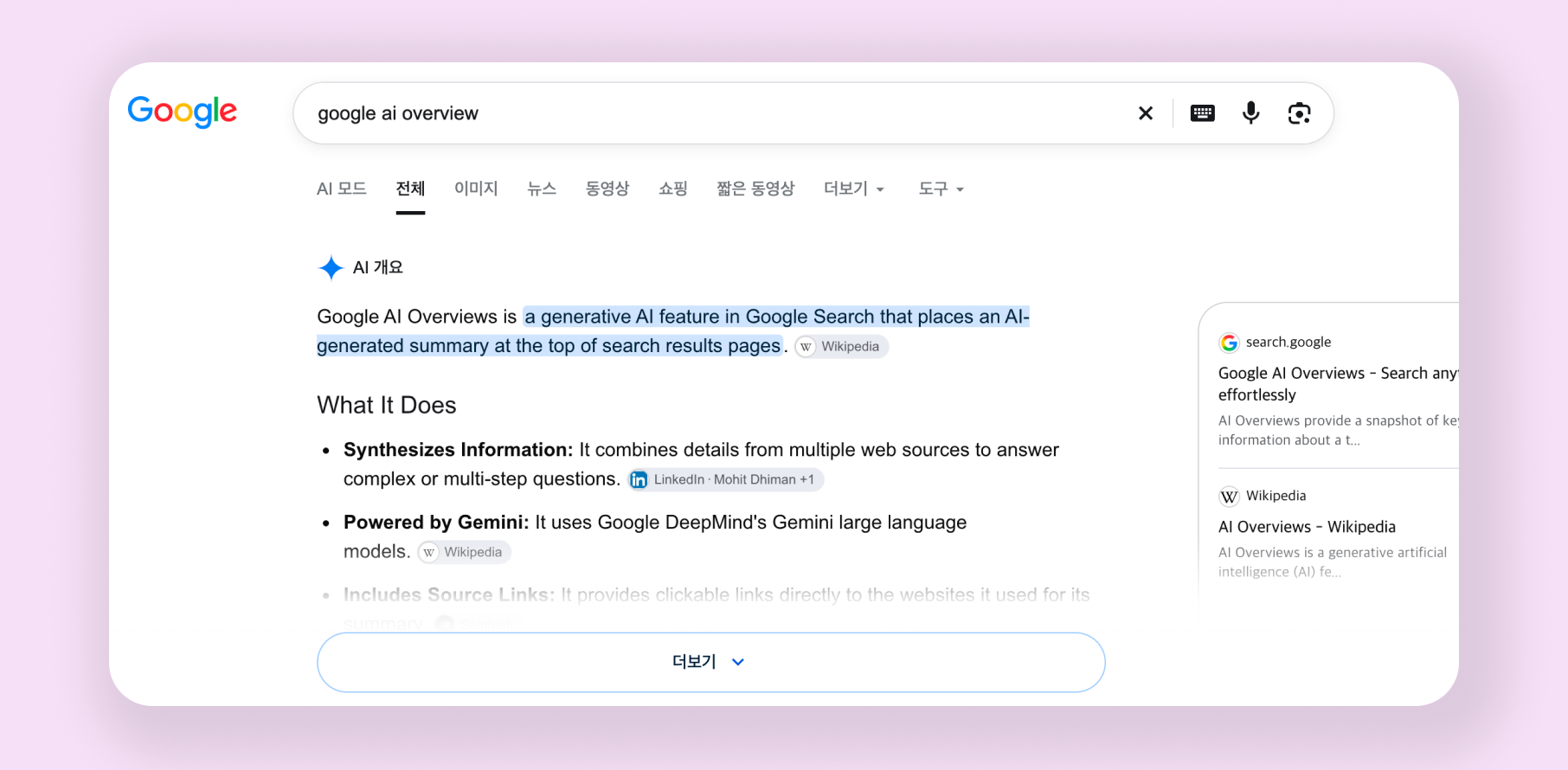
AI search uses AI to synthesize information and provide answers to users’ questions. This article focuses on search experiences that draw on web information, such as web search in ChatGPT and Google AI Overviews. Users can still follow source links to websites, so AI search and zero-click search are not the same thing.
A short definition or basic explanation may be enough to satisfy a user on the search results page. Evaluating software, however, may require a closer look at supported features, integrations, pricing, and use cases. Your response should therefore depend on which types of searches are losing clicks.
AI marketing includes a range of activities, from AI-assisted content creation to data analysis. This article focuses on GEO: responding to how customers discover and compare brands in AI search.
Generative Engine Optimization (GEO) is a content optimization practice focused on how brands and content appear in AI-generated answers. It involves reviewing that visibility and improving the clarity and usefulness of the information you provide.
GEO has many overlapping elements with traditional SEO, including content accuracy, accessibility, and information structure. It adds an emphasis on brand mentions and source citations for the questions customers ask.
| Comparison | What Traditional SEO Primarily Tracks | What GEO Adds |
|---|---|---|
| Visibility | Page impressions and rankings by search query | Brand presence and how the brand is described by question |
| Key metrics | Impressions, clicks, CTR, and organic traffic | Brand mention rate, owned-domain citation rate, and share of mentions versus competitors |
| Content | Useful information and site structure aligned with search intent | Differences between your content and the questions, comparison criteria, and sources appearing in AI answers |
| Performance interpretation | Engagement and conversions after a visit | Separate observation of AI visibility, website traffic, and conversions |
A brand mention in an AI answer does not mean a visit or signup has occurred. Treat visibility as a measure of how often your brand appears in the answers you monitor, and assess business outcomes separately.
Keyword research, internal linking, technical optimization, and content quality remain important. Google also explains that existing SEO best practices apply to its AI search features.
Rankings and clicks alone, however, cannot answer questions such as:
For example, a general page targeting “CRM” may not provide enough information to answer a request for a CRM that a small sales team can integrate with its existing email tools. This is an illustrative example. Beyond describing product benefits, your page needs to address the criteria customers use to make a decision.
Use headings, bullet lists, comparison tables, and summaries to make each section’s purpose clear. Explain supported capabilities alongside limitations. When presenting customer case studies, describe the circumstances and results. Include sources and update dates where relevant.
Identify the questions your ideal users are asking through sales conversations, support requests, and product evaluations. Provide concise answers early in the content, then expand with conditions and exceptions. Use FAQ sections when there are genuine recurring questions to address.
Use structured data appropriate to the page type and ensure it matches the visible content. However, Google does not require special schema markup for inclusion in its AI features. Adding FAQs or schema alone does not secure citations.
Use product and feature names consistently, and use internal linking to connect related feature pages, implementation guides, and customer case studies. Explain which teams the product serves, which problems it addresses, and what customers should check before adopting it.
Choose questions that matter to your business and review whether your brand and competitors appear, how they are described, and which URLs are cited. Base your assessment on patterns across repeated observations rather than a single answer.
When users click through, make it easy for them to find product details, pricing, and demo requests. Check site speed, mobile readability, and navigation alongside the content itself.
Start with questions that matter to adoption decisions and are not sufficiently addressed by your content. If the information already exists, improve its presentation and structure. If it is missing, verify the facts with the product team before adding it.
To know whether GEO strategies are working, track brand mentions and citations, website traffic, and signups or demo requests separately. In a zero-click environment, distinguishing inclusion in an answer from an actual visit is essential to interpreting content performance.
| Measurement Area | What to Track | What to Keep in Mind |
|---|---|---|
| AI visibility | Brand mentions, owned-URL citations, and share of mentions versus competitors by question | Mentions and citations are different; neither represents a click or signup |
| Search performance | Impressions, clicks, and CTR by query and page | Review changes in search demand and rankings as well |
| Website traffic | Identifiable AI referrals, organic traffic, and landing pages | Some visits may lack identifiable referral information |
| Content engagement | Engagement time, views of key information, and onward navigation | Engagement metrics alone do not establish that AI systems favor a page |
| Conversions | Free trial signups, demo requests, and qualified leads | Review both traffic volume and conversion rate, and check for duplication or tracking gaps |
Use Google Search Console for search impressions and clicks, and web analytics tools such as GA4 for behavior and conversions after a visit. Collect signup and demo-request events and mark them as key events. Assess lead qualification using follow-up data such as CRM records.
Collecting and analyzing AI answers requires separate measurement. Google includes performance from its AI search features in Search Console’s Web search data. That aggregate should not be treated as a dedicated AI-only report.
There is no reliable universal percentage of lost traffic that GEO will recover. Start with a baseline: record the current position, the pages and dates you change, and the questions you will monitor. Then compare results using consistent questions, engines, markets, and languages.
If citations increase but visits do not, report visibility improvements and traffic outcomes separately. If visits increase without more signups, examine visitor intent and the conversion path. Record other marketing activities and changes in the search environment rather than attributing every before-and-after difference to your content updates.
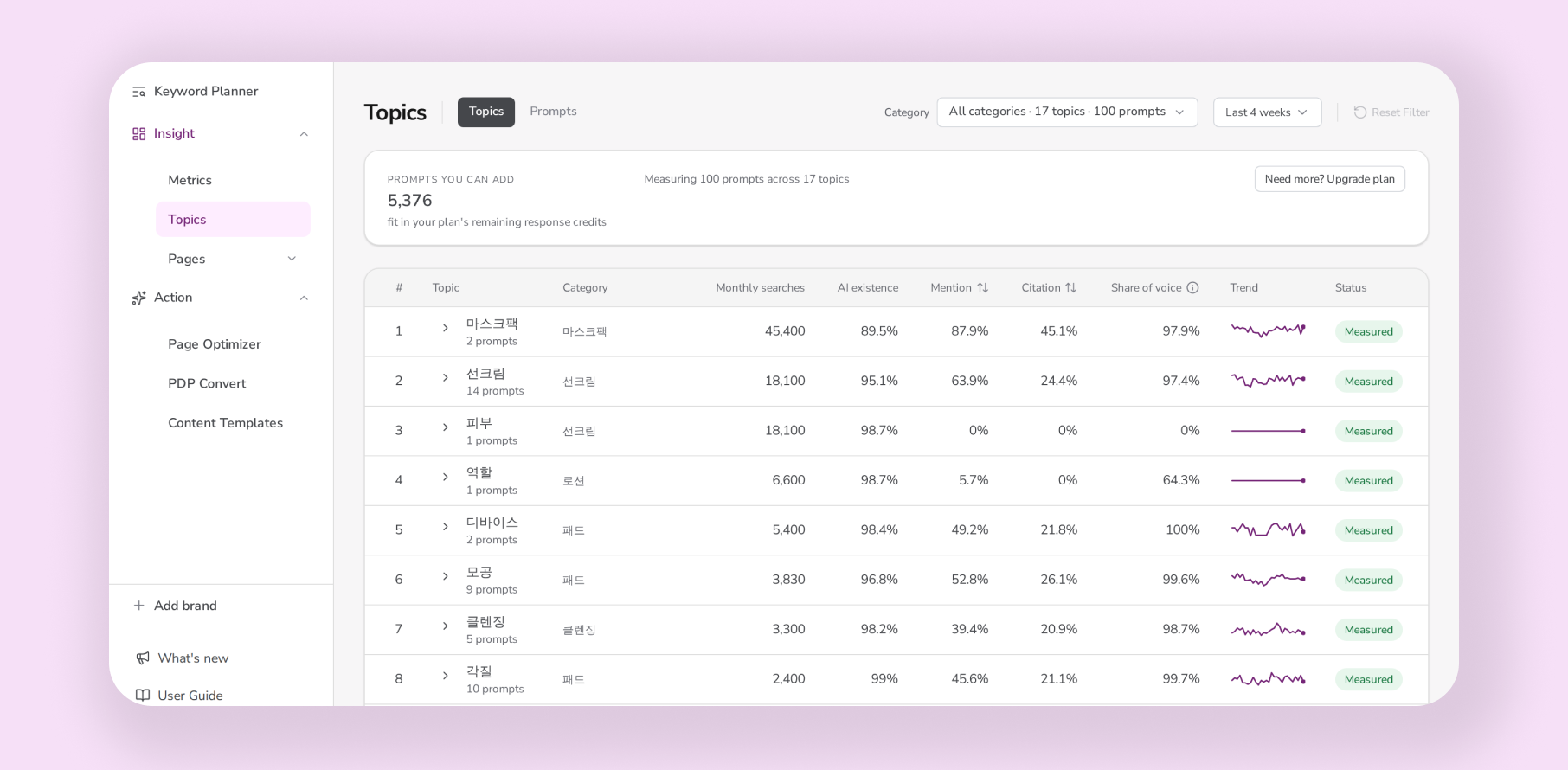
To compare performance in AI answers, you need to monitor responses to the same prompts over time. VIVI Insight collects AI answers by question and tracks brand mention rate, owned-domain citation rate, and share of voice against competitors.
 collects AI answers by question and tracks brand mention rate, owned-domain citation rate, and share of voice against competitors.](https://ohtbkghgjukjdpeqxmhb.supabase.co/storage/v1/object/public/article-images/27e78d00-486f-4973-bd31-4c5ec6698bf3/202611/e2e62250-89d7-48ff-8d21-721c23621097.png)
Together, these metrics show whether your brand appears more often, whether your content is used as a source, and how the visibility gap between your brand and competitors changes.
Reviewing website traffic and signup data alongside these metrics helps you distinguish changes in AI visibility from outcomes after a visit. Use VIVI Insight to track the results of your GEO activities and establish a measurement baseline for your next objectives.
→ Sign up for VIVI and measure your brand’s AI search performance
Finding that your brand is not appearing prominently in AI answers does not immediately tell you what to change. You still need to decide whether to create more content, improve existing pages, and what to review after making changes.
Breaking the problem into specific tasks makes it easier to find a starting point.
| Common Obstacle | How to Address It |
|---|---|
| We do not know which page to improve first. | Start with questions that matter to customers’ adoption decisions. Check whether a relevant page exists and whether it lacks essential information, then set priorities. |
| We are unsure whether to update an existing page or create a new one. | If an existing page addresses the same question, strengthen the explanation. Consider new content when a distinct use case or set of comparison criteria needs its own treatment. |
| We do not know what to add or how much to change. | Review the answers and cited sources, then identify the features, integration requirements, and usage conditions customers want to understand. Check these against your product documentation and fill gaps in information and evidence. |
| Revised copy does not make it onto the website. | Agree on reviewers, publishing owners, and the required format while drafting. After publication, check that the text, tables, and links appear as intended. |
| It is difficult to assess the impact of an update. | Record the page and edit date, then observe changes in mentions and citations for the same questions. Review website traffic and conversions alongside them. |
The important thing is to address the information needed for one question and follow through with publication and measurement. Repeating this process makes it easier to identify the next page to improve and the work it requires.
 can help turn an improvement direction into concrete changes.](https://ohtbkghgjukjdpeqxmhb.supabase.co/storage/v1/object/public/article-images/27e78d00-486f-4973-bd31-4c5ec6698bf3/202611/5a2da823-8a92-4dad-95da-e487e5efa027.png)
VIVI Page Optimizer can help turn an improvement direction into concrete changes. Page Optimizer reviews the technical elements and content of an existing page and proposes GEO improvements. Your team can verify the accuracy and supporting evidence of the proposed changes, then download the final version as Markdown or HTML for your CMS.
Use VIVI Page Optimizer to identify gaps on your website and turn pending improvements into action.
→ Sign up for VIVI and get GEO improvement recommendations
| Phase | Actions | Owners and Tools | Output |
|---|---|---|---|
| Audit and baseline | Review declining queries and pages alongside current AI answers | Marketing and SEO / Search Console, web analytics, and AI visibility measurement | Traffic trends and a baseline for each question |
| Strategy definition | Select important questions and pages to improve | Marketing and product teams | Priorities and metrics to monitor |
| Content improvements | Strengthen answers, comparison information, and evidence; review the changes | Content and product teams / Page Optimizer | Reviewed copy and a record of changes |
| Technical and on-page review | Check accessibility, indexing, internal linking, and mobile usability | Development and SEO teams | Implemented fixes |
| Monitoring and feedback | Compare changes in mentions and citations with traffic and conversion trends | Marketing and analytics teams | The next improvement tasks |
| Ongoing operations | Update content and questions as the product changes | Content operations, product, and customer support | Repeatable review and measurement procedures |
If organic traffic is declining, start by examining what has changed in the way customers discover your brand. Review which searches are losing visits, how AI answers describe your brand, and whether your content adequately addresses customers’ questions.
Adding AI search to your AI marketing strategy can begin with a small step. Choose one question that matters to a customer’s adoption decision and one relevant page. Build on your existing SEO foundations, fill gaps in the information, and track what changes. This will help you identify the next practical action for your brand.
When customers ask AI for advice, is your brand among the options?
→ Discover your brand’s AI search visibility and missed opportunities with VIVI