Agentic Commerce: What Ecommerce Brands Need to Prepare
How can ecommerce brands prepare for agentic commerce? Explore insights from 6,720 AI shopping responses and four ways to improve product visibility.
How can ecommerce brands prepare for agentic commerce? Explore insights from 6,720 AI shopping responses and four ways to improve product visibility.
How can ecommerce brands prepare for agentic commerce? Explore insights from 6,720 AI shopping responses and four ways to improve product visibility.
How can ecommerce brands prepare for agentic commerce? Explore insights from 6,720 AI shopping responses and four ways to improve product visibility.
How can ecommerce brands prepare for agentic commerce? Explore insights from 6,720 AI shopping responses and four ways to improve product visibility.
In South Korea and the US, approximately 70% of AI responses to shopping-related queries recommended specific, purchasable products. AI is moving beyond general product advice to recommending individual items based on shoppers' needs.
ChatGPT, Google AI Mode, and Naver AI Tab rely on different information sources and direct shoppers to different purchasing channels. Brands need to prioritize their optimization efforts accordingly.
To prepare for agentic commerce, ecommerce businesses should review their product page content, marketplace listings and reviews, product feeds, and integrations with AI shopping platforms.
Imagine a shopper asking ChatGPT, "Can you recommend a serum for dark spots after a summer vacation, suitable for someone in their 30s?"
AI can compare products based on the shopper's skin concerns and intended use, then suggest retailers where those products can be purchased. But would your product make the recommendation list?
This shift toward AI-assisted product discovery, comparison, and purchasing is known as agentic commerce. In South Korea, services such as Naver's Shopping Agent and ChatGPT's shopping features are expanding, changing how consumers discover products and choose where to buy them.
So, what should ecommerce businesses do now to prepare for AI shopping?
On November 11, BubbleShare CCO Heesook Lee delivered a presentation titled "Is AI Recommending Your Products?" at the Digital Marketing & Technology Summit (DMTS). For the presentation, BubbleShare analyzed 6,720 AI-generated responses to skincare shopping queries in South Korea and the United States using VIVI, its AI search visibility platform.
The analysis examined which product information AI engines reference when making recommendations and which purchasing channels they direct consumers to. In this article, we'll explore the findings and outline practical steps ecommerce teams can take to improve their product visibility in AI shopping.
BubbleShare's analysis found that approximately 70% of AI responses to shopping-related queries in both South Korea and the US recommended specific products available for purchase.
To investigate, BubbleShare developed 240 skincare shopping queries and collected four responses per query across four AI engines in South Korea and three in the US. The dataset included 3,840 responses from South Korea and 2,880 from the US, totaling 6,720 responses collected on November 3–4, 2026.
| Market | AI responses recommending specific products |
|---|---|
| South Korea | 69–73% |
| United States | 70–73% |
Source: BubbleShare VIVI skincare shopping analysis, November 3–4, 2026. Four AI engines in South Korea and three in the US.
AI is no longer limited to explaining product features or offering general shopping advice. It is increasingly recommending individual products that consumers can actually purchase.
Consider two different questions: "Which ingredients help with dark spots?" and "Can you recommend a serum for dark spots after a summer vacation, suitable for someone in their 30s?"
The first question may lead to an explanation of skincare ingredients and treatment options. The second calls for product recommendations based on a shopper's specific skin concerns and intended use.
For brands, the important question is under which shopping conditions their products appear in AI recommendations. Checking whether AI recognizes your brand or responds correctly when someone searches for your product name is no longer enough.
Brands also need to understand whether their products are recommended when shoppers describe their needs, budgets, preferences, or intended use without mentioning a brand.
In AI shopping, visibility matters not only among consumers who already know your brand, but also among those who have yet to decide what to buy.
Once AI recommends your product, the next question is where it obtained the information and which purchasing channel it recommends. BubbleShare analyzed the sources cited across 3,840 AI responses to skincare shopping queries in South Korea, revealing clear differences in the websites and content types referenced by each AI engine.
| Information source | Google AI Mode | Gemini | ChatGPT | Naver AI Tab |
|---|---|---|---|---|
| Brand-owned product pages | 23% | 22% | 25% | 2% |
| Marketplace product pages | 22% | 23% | 27% | 4% |
| Naver blogs and communities | 26% | 0% | 0% | 24% |
| News and professional sources | 2% | 5% | 20% | 1% |
Source: BubbleShare VIVI, 3,840 South Korean skincare shopping responses, November 3–4, 2026. Citation shares by source category; selected categories shown.
For ChatGPT, marketplace product pages accounted for 27% of citations, followed by brand-owned product pages at 25%. Google AI Mode frequently referenced Naver blogs and communities, which accounted for 26% of citations. Naver AI Tab, meanwhile, relied heavily on product information available within Naver's own ecosystem.
These findings suggest that creating more content is not necessarily the first step toward improving AI search visibility. Depending on which AI engines matter most to your business, improving product information on existing brand websites and marketplace listings may be a more practical starting point.
The differences extended beyond information sources to the purchasing links included in AI responses. In South Korea, 67% of product links provided by Google AI Mode led to domestic ecommerce channels. For ChatGPT, 58% pointed to brand-owned online stores, while approximately 96% of links in Naver AI Tab led to Naver Shopping.
In other words, even when AI recommends the same product, the purchasing channel presented to consumers can vary significantly by AI engine.
BubbleShare's VIVI data also revealed substantial differences between brands within the same skincare category.
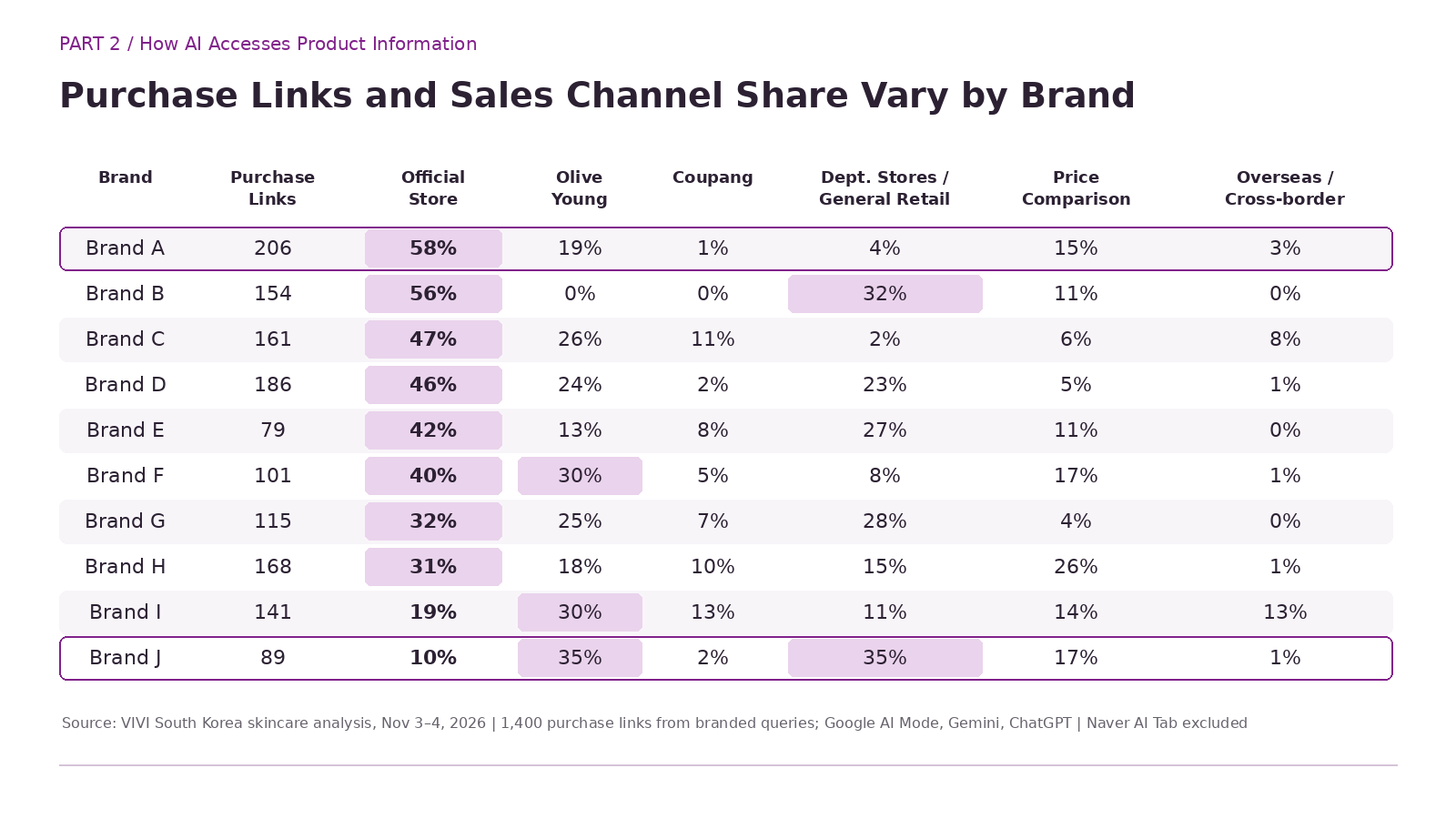
The analysis covered approximately 1,400 AI-generated purchase links associated with ten skincare brands in South Korea. For Brand A, 58% of its 206 purchase links directed shoppers to its official online store. For Brand J, however, only 10% of its 89 purchase links led to its official store. Olive Young and department stores or general retailers each accounted for 35%.
| Metric | Brand A | Brand J |
|---|---|---|
| AI-generated purchase links | 206 | 89 |
| Official online store | 58% | 10% |
| Olive Young | 19% | 35% |
| Department stores and general retailers | 4% | 35% |
Source: BubbleShare VIVI analysis of ten South Korean skincare brands, approximately 1,400 purchase links from branded queries across Google AI Mode, Gemini, and ChatGPT, November 3–4, 2026. Brand names anonymized.
This means that getting recommended by AI does not necessarily mean shoppers will be directed to your preferred sales channel.
A higher share of official-store links is not always better. For brands that rely heavily on marketplace sales, links to retailers such as Olive Young or department stores may be equally valuable. What matters is whether the purchasing channels recommended by AI align with your brand's sales strategy.
For example, if acquiring new customers through your direct-to-consumer website is a priority, you may want to monitor how often ChatGPT links to your official product pages. If increasing sales through Olive Young is the goal, you should check whether AI directs shoppers to the correct Olive Young listings.
AI shopping performance is not just about whether your products are recommended. It is also about where those recommendations lead potential customers.
Major ecommerce platforms such as Coupang and Naver Shopping restrict access for certain external AI crawlers. These restrictions can prevent AI systems from directly accessing and reading product information on their pages. Does that mean products listed on these marketplaces are unlikely to appear in AI search results?
Not necessarily. BubbleShare examined both the crawler access settings of major ecommerce platforms and the actual responses generated by AI engines.
The analysis showed that even when an AI system cannot directly access a product page, it may still provide product or purchasing links using conventional search engine results.
For example, when asked, "Compare the prices of AESTURA ATOBARRIER cream on Olive Young and Coupang," Google AI Mode cited a Coupang product page as a source. ChatGPT, meanwhile, provided relevant shopping links based on search results, despite restrictions on direct access to Coupang's product pages.
Similar patterns appeared with Naver Shopping.
When asked, "Where can I buy authentic Beauty of Joseon sunscreen?" ChatGPT provided a Naver price comparison search link, allowing shoppers to explore multiple sellers.
When asked, "Are there any official store discounts for Sulwhasoo Concentrated Ginseng Rejuvenating Cream?" ChatGPT included a link to the official Sulwhasoo brand store on Naver.
The key distinction is that an AI engine's ability to read a product page directly is different from its ability to provide a link to that product or retailer.
For ecommerce teams, this means checking crawler accessibility alone is not enough. Brands should also examine where AI sends customers when they ask about prices, authorized sellers, or purchasing options.
For example, on Naver's price comparison pages, check whether official sellers and accurate product information are easy to find. On official brand stores, make sure current discounts and promotions are reflected correctly.
Even when a marketplace controls AI crawler access, brands can still manage the accuracy of their product information and the purchasing experience.
As the data shows, AI engines use different methods to access product information and guide shoppers toward purchasing channels. So what should ecommerce businesses focus on first?
In the DMTS presentation, BubbleShare identified four primary ways AI engines obtain product information: web crawling, platform-native data, product feeds, and partnerships or integrations.
| Area | How AI accesses product information | What ecommerce teams should check |
|---|---|---|
| 1. Web crawling | Reads publicly accessible webpages | AI crawler access and text content on product pages |
| 2. Platform-native data | Uses product information stored within shopping platforms | Product attributes, prices, reviews, and promotions |
| 3. Product feeds | Uses structured product data submitted by merchants | Product information in Google Merchant Center and Naver EP |
| 4. Partnerships and integrations | Receives product data directly from connected commerce platforms | ChatGPT app integrations and ecommerce platform connections |
Many of these areas are already part of everyday SEO and ecommerce operations. Before introducing entirely new workflows, start by reviewing whether your existing product information is accessible and useful to AI systems.
Product detail pages are one of the most important places where brands can explain their products directly.
However, many ecommerce websites in South Korea rely on long, image-based product descriptions containing ingredients, instructions, and test results. When important details exist only inside images, AI systems that rely on webpage text may miss information needed to understand and recommend the product. The solution is not simply to add more text. What matters is clearly explaining who the product is for, when it should be used, and why someone might choose it.
When Google AI Mode was asked, "Which is better for improving skin firmness in your 40s: Sulwhasoo Concentrated Ginseng Rejuvenating Cream or a regular retinol cream?", it compared the products based on concerns such as dryness and loss of firmness. The response drew on information about ginseng ingredients and firming benefits from Sulwhasoo's product page to explain why the cream could be relevant to shoppers concerned about dryness and loss of skin volume.
Another example involved AESTURA ATOBARRIER365 Cream. When asked, "Is AESTURA ATOBARRIER365 Cream suitable for oily skin?", Gemini referenced customer reviews from the Amore Mall website, using descriptions of the capsule texture, application experience, and absorption.
The two examples highlight different types of information that AI can use. In the Sulwhasoo example, AI referenced the product benefits and ingredients emphasized by the brand. In the AESTURA example, it drew on real customers' experiences.
Product descriptions help AI explain why a product may be worth choosing, while customer reviews help answer questions about how the product performs in real-life use.
This means product pages should explain not only ingredients and features but also relevant customer needs and use cases. Similarly, review strategies should consider more than review volume. Information about skin types, product texture, usage experience, and purchase motivations can help shoppers make informed decisions.
Start by checking the following:
Are ingredients, specifications, and usage instructions available as HTML text rather than only within images?
Does the page clearly explain who the product is for and when it should be used?
Do customer reviews include skin types, product texture, and actual usage experiences?
Can AI search crawlers access the page, and is the product structured data correctly implemented?
For AI shopping services that rely on their own platform data, such as Naver Shopping Agent and Naver AI Tab, product listings and customer reviews are especially important.
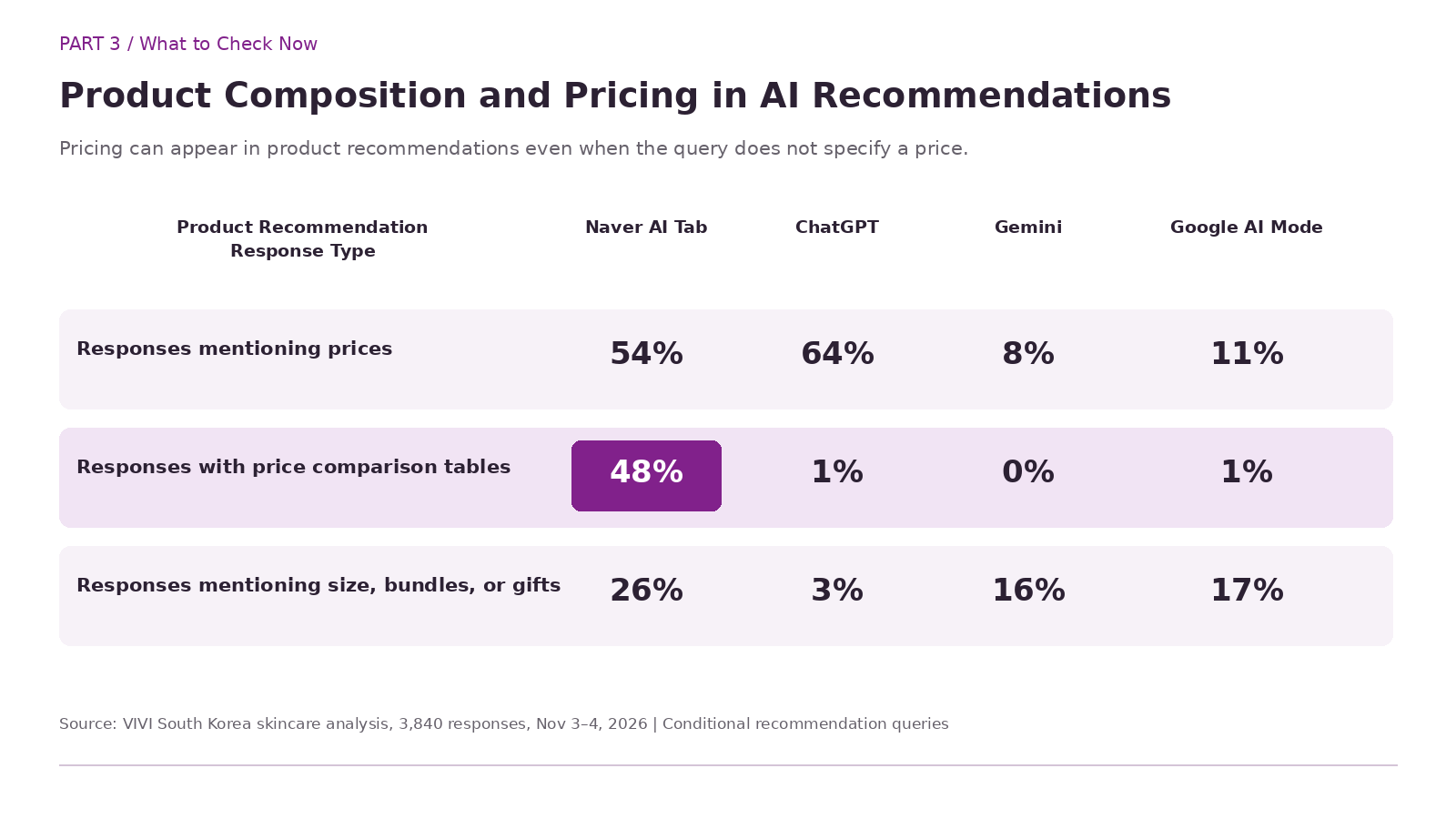
Price and product bundle information also appear frequently in AI-generated responses. BubbleShare's analysis of skincare product recommendation queries found that 54% of Naver AI Tab responses and 64% of ChatGPT responses included pricing information.
However, the way each engine presented that information differed considerably.
| Metric | Naver AI Tab | ChatGPT |
|---|---|---|
| Responses mentioning prices | 54% | 64% |
| Responses containing price comparison tables | 48% | 1% |
| Responses mentioning volume, bundles, or promotional gifts | 26% | 3% |
Source: BubbleShare VIVI, South Korean skincare shopping responses, conditional product recommendation queries, November 3–4, 2026.
Price comparison tables appeared in 48% of Naver AI Tab responses, compared with just 1% of ChatGPT responses. This suggests that Naver AI Tab was far more likely to present product prices in a side-by-side comparison format.
AI also included pricing and bundle details even when consumers did not explicitly ask for prices. For example, when someone asks, "Can you recommend a good-value toner in a large size?", information such as product volume, unit price, and promotional bundles can help distinguish competing products. Ecommerce teams should therefore verify that pricing, product volume, bundle contents, and promotional offers are accurately reflected in their listings.
This is particularly important during promotional periods when prices and bundles change frequently. Make sure product titles and descriptions reflect current offers and that information remains consistent across sales channels.
Product feeds are structured datasets that merchants use to provide shopping platforms with information such as product names, prices, availability, images, and attributes. Two examples are Google Merchant Center and Naver EP.
In Google Merchant Center, brands can include the brand name and relevant product attributes in product titles, while using product descriptions to communicate details such as ingredients, instructions, and intended users. For example, a toner designed for sensitive skin should have a clear product name that includes the brand and size. Its description can explain key ingredients and the situations in which the product may be suitable.
The DMTS presentation also highlighted AI conversational question-and-answer fields in Google Merchant Center, which allow merchants to provide information addressing questions shoppers may ask before purchasing.
For Naver EP 3.0, ecommerce teams can review recommended fields beyond the required attributes, including brand names, barcodes, product specifications, search tags, and unit prices. Accurate product identifiers are particularly important when the same product is sold through multiple retailers, as they help platforms match listings and compare prices for the same item.
Rather than creating entirely new product datasets, start by filling in missing information and making sure prices and inventory details match across product feeds and product pages.
Another way AI systems obtain product information is through direct connections with ecommerce platforms and retailers.
The DMTS presentation featured an example of the Amore Mall app within ChatGPT, where shoppers could discover products and navigate to their purchasing pages. When shoppers used the Amore Mall app through ChatGPT, product cards displayed information such as prices, discounts, ratings, and review counts. Selecting a product card directed the shopper to the corresponding Amore Mall product page.
Unlike conventional web crawling, this approach allows a connected commerce platform to provide product data directly to the AI service. Ecommerce businesses should check which AI platforms are supported by their current ecommerce solutions and retail partners. However, even when direct integrations are available, maintaining accurate product descriptions and reviews remains important for broader AI search visibility.
Of the four approaches discussed above, improving product detail pages is often one of the most practical starting points for ecommerce teams.
If product descriptions are embedded in long images, brands do not necessarily need to redesign the entire page. Instead, they can make the information within those images available as readable text.
BubbleShare's VIVI PDP Converter extracts product information from existing product page images and converts it into structured text and HTML. This allows brands to present information such as ingredients, product benefits, and use cases in HTML that can be added to their ecommerce websites.
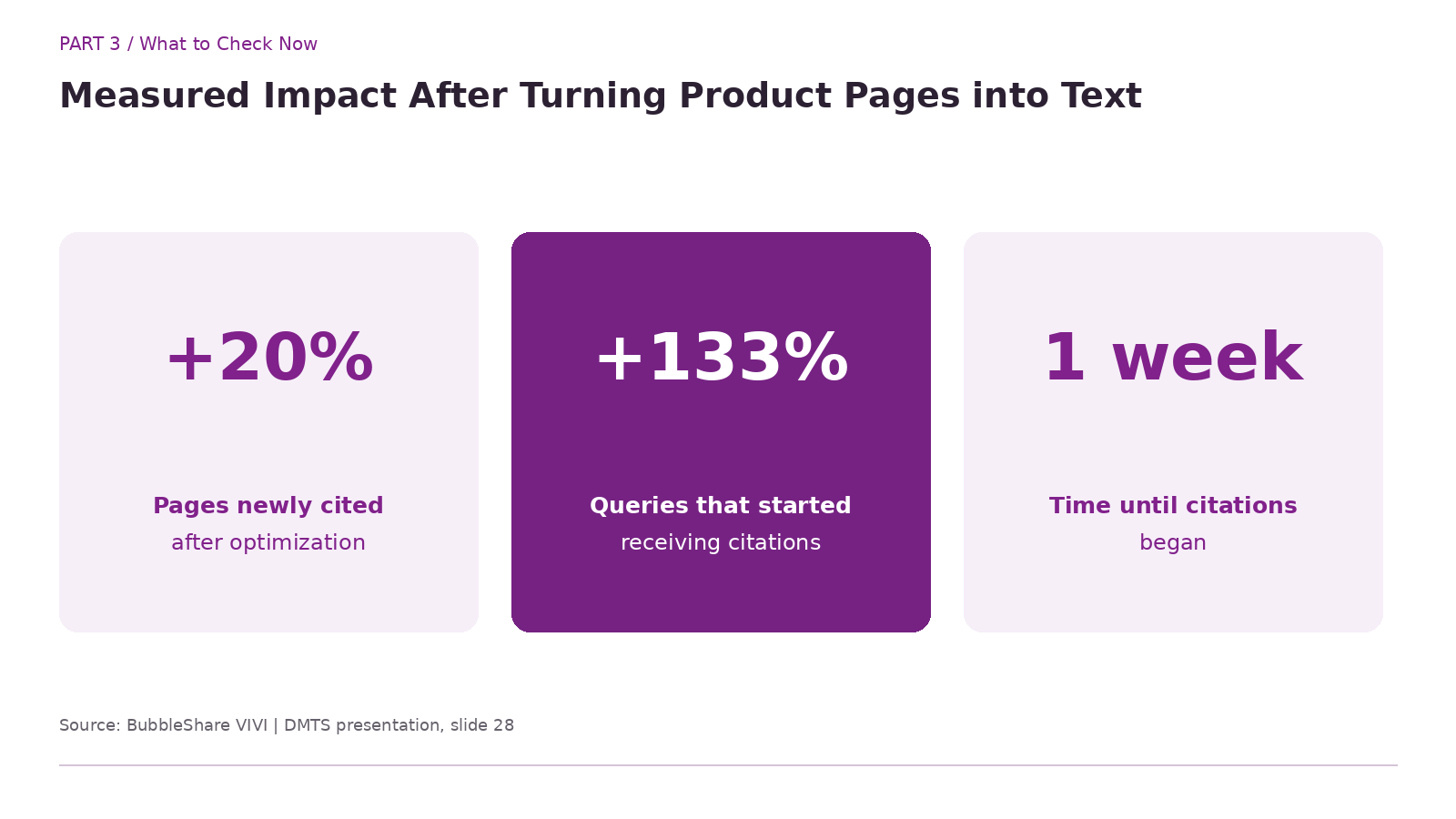
BubbleShare converted product information embedded in image-based pages into text and compared AI citation performance before and after the changes.
The results showed that 20 previously uncited pages began receiving AI citations, while the number of shopping queries generating citations increased by 133%. AI citations were observed approximately one week after the optimization.
| Metric | Observed result |
|---|---|
| Previously uncited pages that began receiving citations | 20 |
| Increase in queries generating citations | +133% |
| Time until citations were observed | Approximately one week |
Source: BubbleShare DMTS presentation, product detail page text optimization case study.
What makes this example particularly relevant is that the brand did not need to rebuild its product pages from scratch. Instead, it retained the existing visual content while making the underlying product information available as text.
For ecommerce teams, this offers a practical starting point: before investing in a major product page redesign, consider whether the information you already have is accessible and useful to AI systems.
Try VIVI and optimize your product pages for free
Preparing for agentic commerce does not require optimizing every product and sales channel at once.
Start with your priority products and sales channels, then examine how AI responds to the shopping questions your customers are likely to ask. From there, identify missing product information, make improvements, and measure whether AI responses change.
At DMTS, BubbleShare outlined a four-step process: Audit → Measure → Optimize → Evaluate.
Review AI crawler access, product page structure, and whether important product details are missing. Comparing your pages with competitors' pages can also reveal opportunities to improve product information.
Build a set of shopping queries based on your products' intended uses and customers' purchasing criteria. Check whether ChatGPT, Gemini, Google AI Mode, and Naver AI Tab recommend your products, which sources they reference, and which purchasing links they provide.
Identify queries where your products are missing from recommendations or where AI provides incomplete descriptions. Improve the relevant product pages with clearer information about ingredients, features, and use cases. Where necessary, convert image-based product descriptions into readable text or update marketplace product listings.
Track changes in product recommendations, citations, and purchasing links using the same queries and AI engines. Combine these findings with data from GA4 and Google Search Console to examine changes in website visits and conversions.
BubbleShare VIVI is a GEO platform that helps brands understand how often their products appear in AI-generated responses, identify gaps in visibility, and improve their content.
Its capabilities include:
AI Engine Monitoring: Track the queries in which your brand and products appear across ChatGPT, Gemini, Google AI Mode, and Naver AI Tab, along with the pages cited as sources.
Purchase Link and Sales Channel Analysis: Identify which product pages AI recommends and compare how frequently shoppers are directed to official stores versus third-party marketplaces.
PDP Converter: Turn image-based product information into readable text and HTML.
Page Optimizer: Identify queries and pages that are not being cited, then generate recommendations for improving the content.
With VIVI, ecommerce teams can monitor visibility by customer query, identify product pages that need improvement, and compare citation performance before and after optimization. By incorporating these checks into existing SEO and ecommerce workflows, brands can make more informed decisions about which products and sales channels to prioritize.
Success in AI shopping is not just about getting your products onto recommendation lists. Brands need to understand which shopping needs trigger recommendations, which product benefits AI highlights, and where consumers are directed to make a purchase.
As BubbleShare's DMTS analysis demonstrated, AI engines differ in both the product information they reference and the purchasing channels they recommend. Even for the same product, the information presented to consumers and the path to purchase can vary depending on the AI engine.
Rather than trying to optimize every sales channel at once, start by examining how your brand currently appears in AI-generated shopping responses. Does AI have enough information to recommend your products? Are your advantages clear when compared with competing products?
The answers may already be found in your existing product pages, product feeds, and customer reviews. Start by making sure the reasons shoppers should choose your products are also clear in the answers AI provides.