How to Check Your AI Search Share of Voice: Do You Show Up More Than Your Competitors?
Learn how AI search share of voice is calculated, how it differs from mention rate, and how to read it in VIVI Metrics to see where competitors are ahead.
Learn how AI search share of voice is calculated, how it differs from mention rate, and how to read it in VIVI Metrics to see where competitors are ahead.
Learn how AI search share of voice is calculated, how it differs from mention rate, and how to read it in VIVI Metrics to see where competitors are ahead.
Learn how AI search share of voice is calculated, how it differs from mention rate, and how to read it in VIVI Metrics to see where competitors are ahead.
Learn how AI search share of voice is calculated, how it differs from mention rate, and how to read it in VIVI Metrics to see where competitors are ahead.
If your brand gets mentioned often in ChatGPT and other AI search tools, does that mean you're doing well against your competitors?
In AI search, how often your brand appears is only part of the picture. You also need to see how often it appears compared with competitors for the same customer questions. Your mentions may have grown, but if competitors appear even more often, your relative visibility may have dropped.
The metric for this is AI search share of voice. Mention rate shows the share of all AI answers that mention your brand. Share of voice shows your share of mentions compared with the competitors you've registered.
This post briefly separates the main AI search metrics, then covers how share of voice is calculated and how to use VIVI to check your performance against competitors and find what to improve.
In traditional search, you could judge a brand's and a page's performance with rankings, impressions and clicks. AI search adds two more questions: did your brand appear in the answer the customer sees, and which websites were cited as sources?
To measure that, you first choose the questions customers might ask AI. A beauty brand, for example, might pick questions like "What's a good hair treatment for dyed hair?" or "Which hair products work for heat damage?" and check which brands and products come up across AI search engines.
Bubbleshare's VIVI measures those customer questions across multiple AI search engines on a regular schedule, then analyzes the collected answers for brand mentions and website citations.
Three metrics come up most often.
| Metric | What it means | What to check |
|---|---|---|
| Mention rate | Share of all AI answers that mention your brand | How often does your brand show up for customer questions? |
| Citation rate | Share of all AI answers that cite your domain as a source | How often is your website used as a source of information? |
| Share of voice | Your share of all mentions across your brand and the competitors you've registered | How often is your brand mentioned compared with competitors? |
Say you measure 50 questions on 3 AI engines and collect 150 answers. If your brand appears in 24 of them, your mention rate is 16%. If your website is cited as a source in 9 answers, your citation rate is 6%.
Those two metrics show how often your brand appears in answers and how often your content is used as a source. To see where you stand against competitors, you need to look at share of voice too.
AI search share of voice adds up the mentions of your brand and your registered competitors across the measured answers, then takes your share of that total.
Share of voice = your mentions ÷ (your mentions + your registered competitors' mentions) × 100
The biggest difference between mention rate and share of voice is the denominator. Mention rate divides by the total number of AI answers. Share of voice divides by the combined mentions of you and your competitors.
Say your brand is mentioned 12 times, and three registered competitors are mentioned 20, 14 and 4 times. Your share of voice is 24%.
Now what happens if you register one more competitor that was mentioned 10 times in the same period?
| Condition | Your mentions | Competitor mentions | Total mentions | Your share of voice |
|---|---|---|---|---|
| 3 competitors registered | 12 | 38 | 50 | 24% |
| 1 competitor added | 12 | 48 | 60 | 20% |
Your actual mentions didn't change, yet your share of voice fell from 24% to 20%. Adding a competitor raised the total number of mentions you're compared against.
That's why AI search share of voice needs a different reading from market share. It isn't your share of the whole market. It's your relative share of mentions among the competitors you monitor.
Knowing the formula is one thing. Measuring is another. Entering dozens or hundreds of brand-related customer questions into ChatGPT, Gemini and other AI search engines by hand, recording which brands appear in each answer, and calculating share of voice from that is not realistic. Keeping up with competitors also means repeating the same questions over time.
Bubbleshare's VIVI Metrics automates the answer collection and metric calculation, so you can see your brand-wide mention rate and citation rate along with your share of voice against competitors. You can also split performance by AI engine and topic, which shows where you're ahead of competitors and where you're behind.
Sign up for VIVI and register your brand and main competitors. Follow the guide below to check your AI search share of voice and see which customer questions competitors win more often.
Check your AI share of voice against competitors with a 7-day free VIVI trial →
In VIVI's Metrics screen, you can see mention rate, citation rate and share of voice for a selected period, along with the change from the previous period. Share of voice also shows where your brand stands among the competitors you've registered.
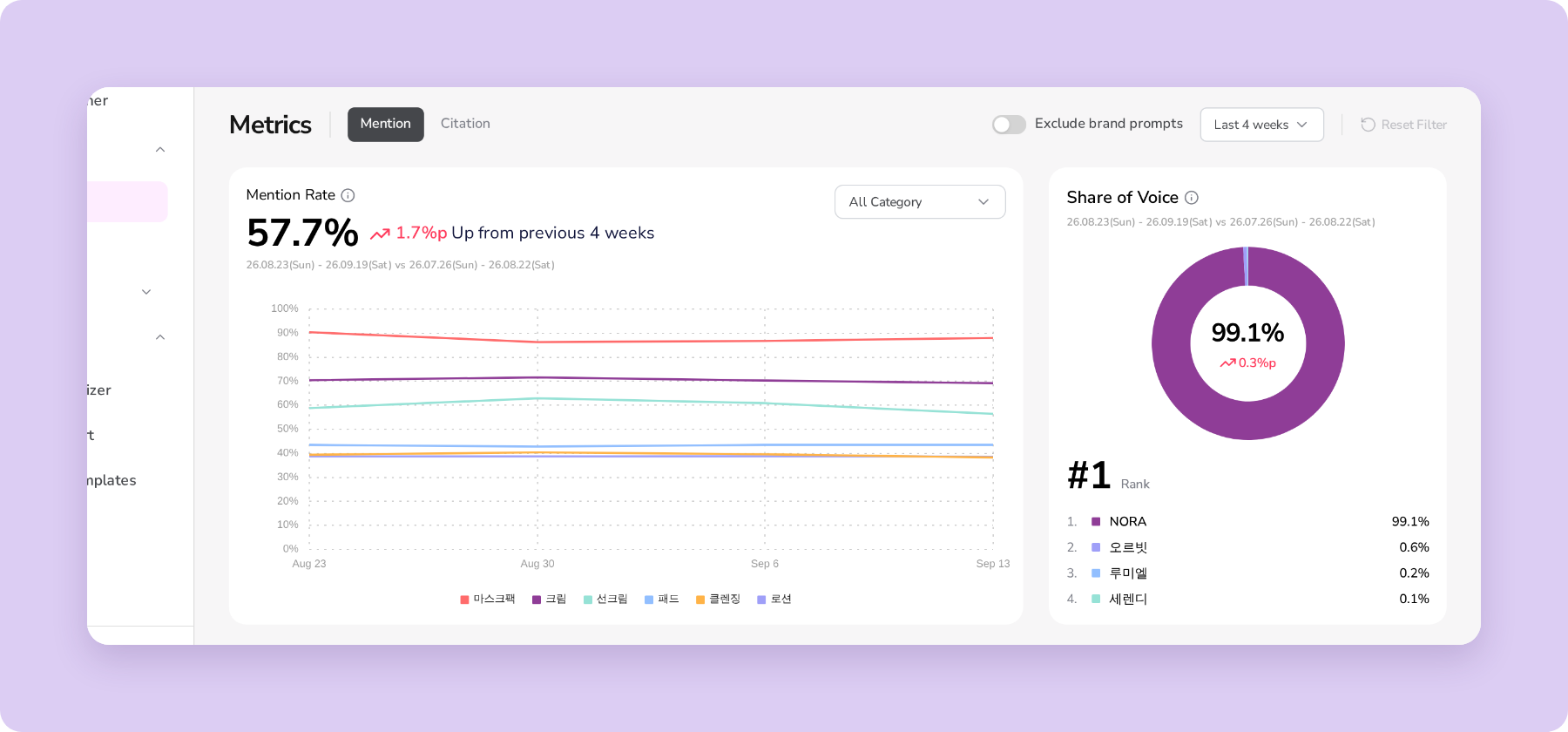
Say your mention rate is up from last month but your share of voice is down. Check whether competitors' mentions grew even more over the same period. Looking at mention rate and share of voice together lets you separate your own growth in visibility from your position against competitors.
One setting worth using here is Exclude brand prompts. With it on, VIVI leaves out questions that contain your brand name when it calculates performance.
If a customer already knows your brand and types its name, the AI answer is likely to include it. For a general question that doesn't name a brand, like "Recommend a good hair treatment for dyed hair," many products can be candidates.
To find out whether your products are discovered by customers who haven't picked a brand yet, not just by those who search for you by name, it helps to look at these questions separately. When you compare periods, keep the Exclude brand prompts setting the same.
Once you've checked brand-wide share of voice, look at which topics and AI search engines mention you less than your competitors.
In Metrics, Breakdowns lets you split share of voice by competitor, AI engine and topic.
Say a hair care brand's overall share of voice is close to its competitors', but competitors appear more often for questions about damaged hair care. In that case, checking how competitors are described in that product category is a good starting point for content improvements.
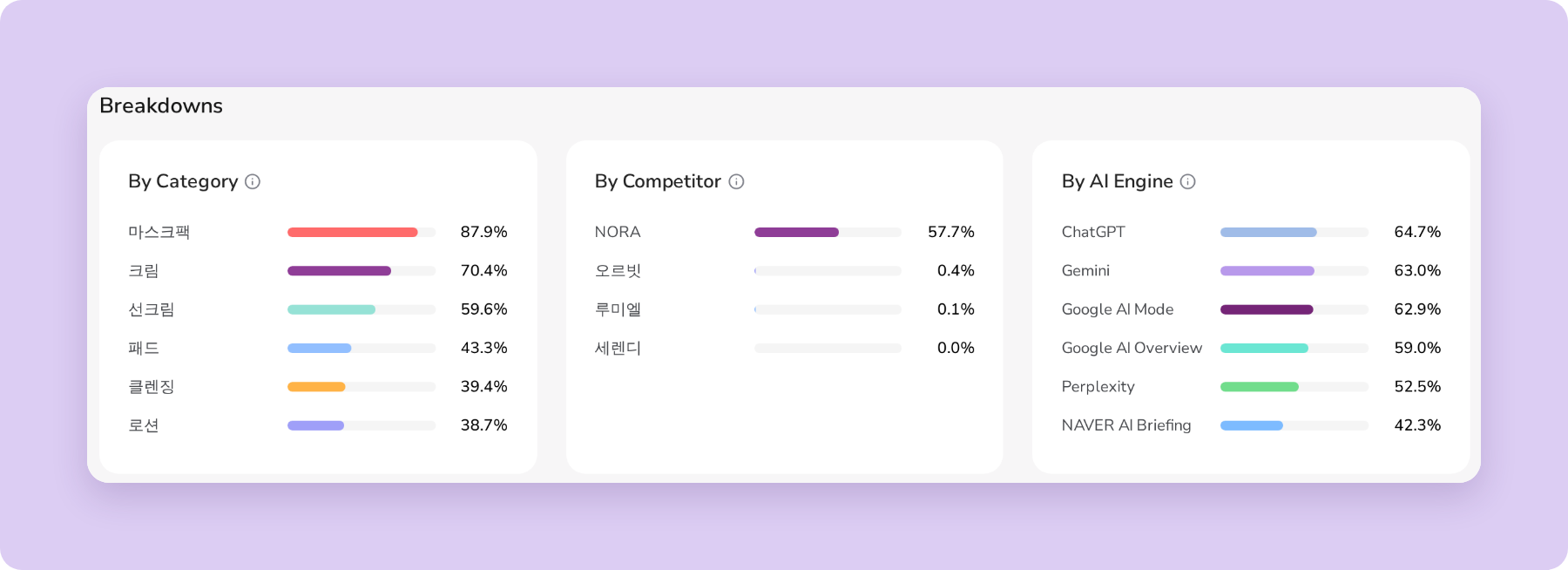
When you compare AI engines, also check AI Existence. It's the share of measured questions for which an AI answer was actually generated.
Google AI Overviews and Naver AI Briefing, for example, may not show an AI answer at all for some questions. If your brand's visibility looks low, you need to tell whether your brand was left out of the answer or no AI answer was generated. That's how you read differences in share of voice between engines and judge what actually needs improving.
Knowing that this month's share of voice is 20% doesn't tell you whether that's good. You also need to see how much it changed from last month and whether the gap with competitors is narrowing.
In VIVI's Compare, you can put the mention rate, share of voice and other metrics for two periods side by side, and see changes by topic, AI engine or competitor.
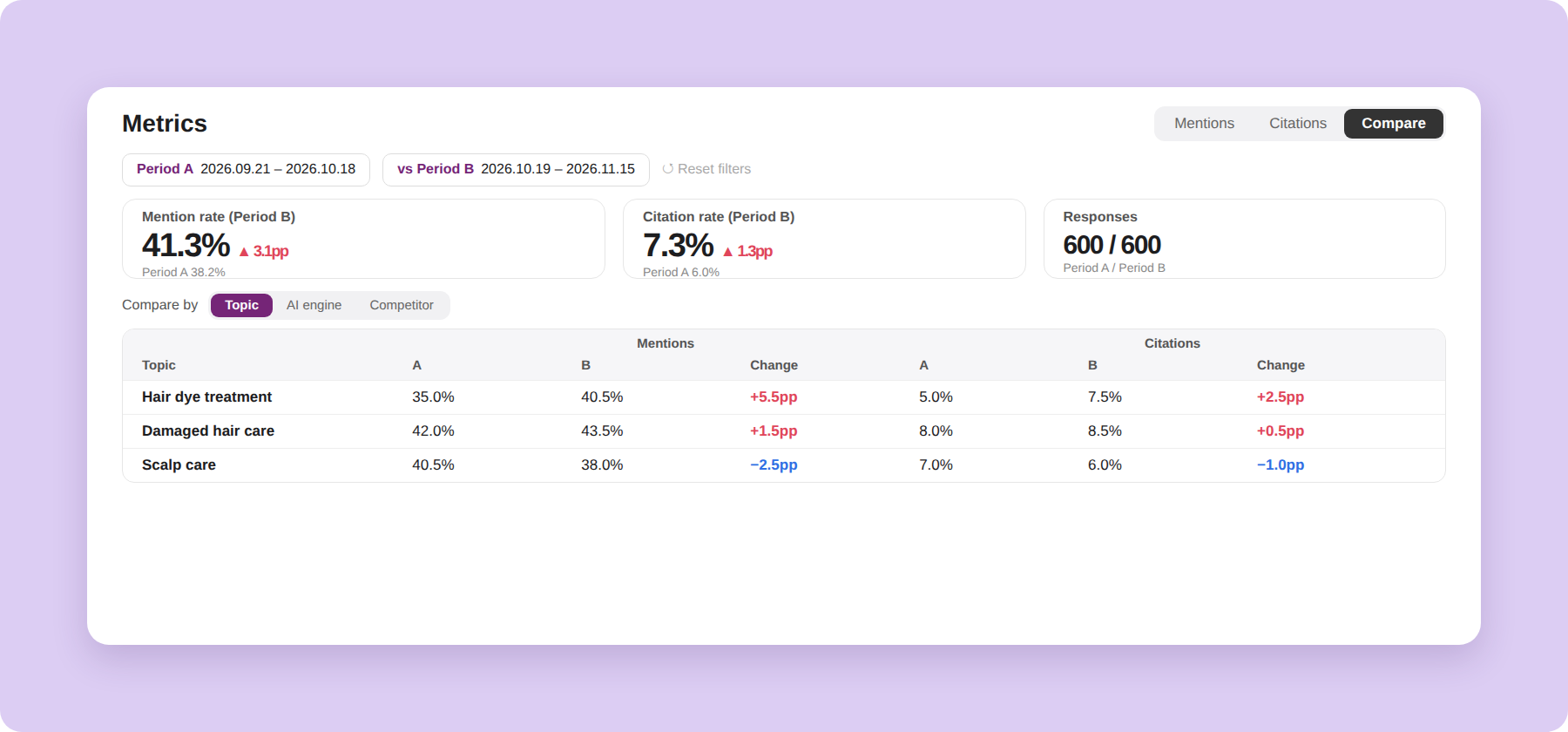
Say your share of voice in a hair care product category rose from last month. Check how your main competitors' mentions changed over the same period. That shows whether you appeared more often or whether a drop in competitor mentions moved your share.
Keep in mind that numbers can shift if the measured questions or the competitor list changed during the comparison period. In Metrics, Prompt changes shows when questions were added or edited, so you can check whether the change happened under the same measurement conditions.
Once you've found a topic or AI engine with low share of voice, check the AI answers to those questions directly.
Topics shows performance by question within a topic, and Prompt Details shows the full AI answer and its cited sources.
Say a hair care brand has a lower share of voice than competitors for the question "Which hair treatment do you recommend for dyed hair?" When you read the AI answers, competitors' products may be described with specific ingredients and usage tips for damaged hair, while yours is mentioned only by name or left out of the recommendations.
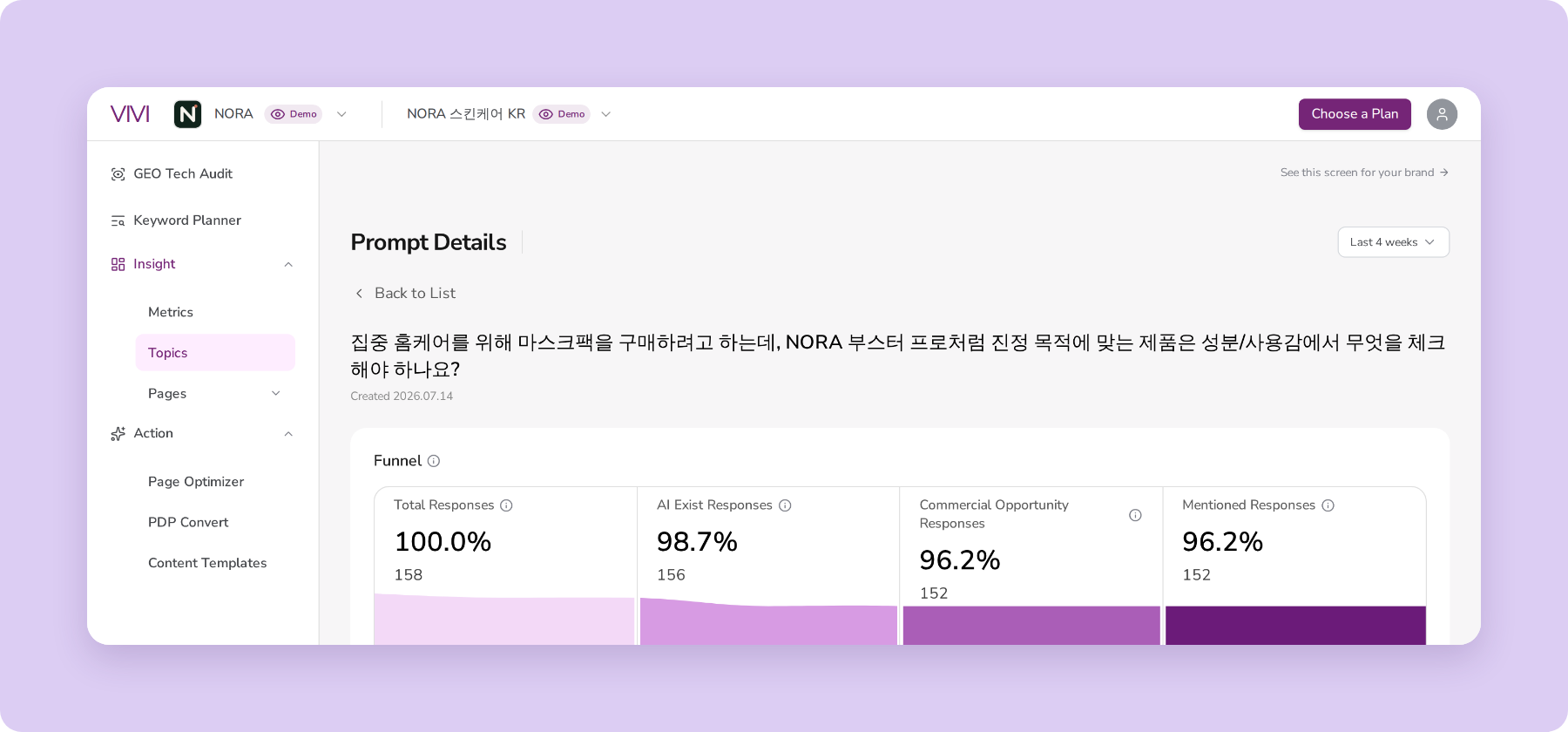
In that case, the low share of voice matters less than which information customers use to compare products and isn't coming through clearly enough. Looking at how competitors' products are described and which sources the AI used lets you pin down what to add to your own product pages.
Reading the actual AI answers is what turns share of voice analysis into your next marketing action. If damaged hair care is a core strength but AI answers don't explain it well, you can add the role of key ingredients, how to use the product and verifiable test results to the product page.
Seeing not only how often competitors appear but also which strengths they're credited with is where share of voice analysis pays off in practice.
Share of voice is useful for understanding brand visibility against competitors, but a number alone can't tell you what caused a result.
Pay particular attention to these three situations.
| Situation | What to consider when reading it |
|---|---|
| Share of voice looks low | The value changes with the competitor list and the topics measured, so check your comparison basis first |
| A direct ChatGPT query and the VIVI numbers disagree | A single AI answer and the result of repeatedly measuring many questions can differ |
| Share of voice rose after you published content | Check other factors too, such as changes in measured questions, competitor mentions and AI models |
There's also no absolute share of voice benchmark that applies to every industry and topic. So don't stop at the current percentage. Look at whether it improved under the same conditions compared with the previous period, and how the gap with your main competitors changed.
If share of voice moved briefly, check whether the measured questions or AI engines changed during that period. AI answers can differ over time, so judge by the trend over a period rather than a single measurement.
Once you've checked AI search share of voice, look at where the gap with competitors comes from and pick the content to improve.
If your overall share of voice is low, don't just add content. First check which categories and customer questions competitors are mentioned for more often.
| What you found | What to check next |
|---|---|
| Share of voice is low on a specific AI engine | Whether that engine generates an answer, and how competitors are mentioned |
| Competitors appear often on a specific topic | How competitors are described in the answers for each question |
| Competitor content is cited repeatedly | The differences between the information in competitor sources and your content |
| Your brand is mentioned but its key differentiators don't come through | Add official content explaining product features, conditions of use and supporting evidence |
If you work in commerce marketing, start with the questions where customers compare products or consider buying. Even with the same share-of-voice gap, a question about general care methods and a question asking for a specific product recommendation can matter very differently to a purchase decision.
Say only competitors' products keep showing up for "Recommend a hair treatment for dyed hair." Check whether your product detail page explains suitability for dyed hair, key ingredients and how to use the product. Compare the features and cited sources in the competitors' answers, then fill in the information that backs up your product's real strengths.
After that, check share of voice and the AI answers again using the same questions and competitor list. Don't let share of voice measurement end as a one-off report. Connect it to content improvements and re-measurement.
Checking how often your brand appears in AI search matters. Checking where you stand against competitors for the same customer questions helps you set content priorities more concretely.
In particular, keep your registered competitor list and measurement conditions consistent while you track share of voice, and analyze what information differs in real AI answers.
With Bubbleshare's VIVI, you can check brand-wide mention rate and share of voice, compare performance by topic and AI engine, and then look at the AI answer and cited sources for each question.
How often is your brand mentioned in AI search compared with competitors? Start a 7-day free VIVI trial to check your AI search share of voice and find what to improve in your next content.
Start your 7-day free VIVI trial →
No. AI search share of voice is your share of brand mentions in AI answers, compared with the competitors you've registered in VIVI. It isn't calculated across the whole market, so changing the competitor list can change the value for the same period.
It can. If the newly registered competitor was mentioned in the measured AI answers, the total number of mentions goes up and your share can fall. That reflects a change in who you're compared against, not a real decline in your brand's performance. When you compare periods, keep the competitor list the same.
AI can generate different answers to the same question depending on timing and conditions. A single answer you check by hand and the result of repeatedly measuring many questions can differ, so check which questions and AI engines VIVI measured.