Agentic Commerce: How to Measure and Improve Your Products' AI Citation Performance
Learn how to measure AI product recommendations and citations in agentic commerce, optimize product detail pages, and track improvements with VIVI.
Learn how to measure AI product recommendations and citations in agentic commerce, optimize product detail pages, and track improvements with VIVI.
Learn how to measure AI product recommendations and citations in agentic commerce, optimize product detail pages, and track improvements with VIVI.
Learn how to measure AI product recommendations and citations in agentic commerce, optimize product detail pages, and track improvements with VIVI.
Learn how to measure AI product recommendations and citations in agentic commerce, optimize product detail pages, and track improvements with VIVI.
Agentic commerce, where AI compares products based on shoppers' needs, recommends options, and even directs customers to places to buy, is attracting growing attention. As AI shopping becomes another way for consumers to discover products, generative engine optimization (GEO) is becoming increasingly important for ecommerce brands.
Traditionally, marketers focused on how prominently their products appeared in search results and shopping platforms. Now, they also need to understand how AI recommends and describes their products when customers specify what they want to buy.
So where should ecommerce marketers start? Rather than immediately updating product detail pages or producing more content, the priority is to identify which customer queries trigger product recommendations, understand what information AI uses, and improve the areas that need attention.
In this guide, we'll cover how to measure AI recommendations and citations with BubbleShare's VIVI Insight, improve product detail pages with PDP Convert, and evaluate the results.
Preparing for AI shopping means understanding more than how often your products appear in AI-generated responses. It's equally important to know which product features AI highlights and which pages it cites as sources. Together, these insights help marketers identify gaps against competitors and prioritize content improvements.
A practical approach follows three stages: Measure → Improve → Measure Again. Repeating this process helps ecommerce teams move beyond monitoring AI visibility to deciding which product information and content should be improved first.
| Stage | What to Do | VIVI Feature |
|---|---|---|
| Measure | Check whether products are recommended, how they are described, and which sources AI cites | VIVI Insight |
| Improve | Fill gaps in product information and optimize product detail pages | PDP Convert |
| Measure Again | Track changes in recommendations and citations for the same customer queries | VIVI Insight |
The goal of measuring AI shopping performance is to understand how often your products appear during product discovery and how they are presented, both quantitatively and qualitatively.
This requires identifying questions customers are likely to ask, collecting responses from multiple AI search engines, and analyzing brand mentions and cited sources. Manually repeating hundreds of queries and recording each response, however, is difficult to sustain.
VIVI Insight by BubbleShare automates this measurement process, allowing marketers to monitor their brand's visibility in AI search and examine the actual responses.
With VIVI's 7-day free trial, you can follow the five steps below to measure your brand's GEO performance and identify opportunities for improvement.
Start Your 7-Day Free Trial and Check Your AI Shopping Visibility →
Begin by choosing one priority product whose visibility in AI shopping you want to assess. This could be a high-revenue product, a product in a competitive category, or one with a detail page you are planning to improve.
Next, identify the questions customers might ask AI when searching for that product. Rather than focusing on product names alone, include the use cases and purchase criteria customers actually consider.
For example, a portable humidifier brand might track questions such as:
Recommend a compact humidifier for an office desk.
What are some quiet portable humidifiers?
Recommend a mini humidifier that's easy to clean.
In VIVI Insight, use Topics to check whether these queries are already being monitored and add any missing ones. Tracking questions associated with different purchase criteria helps reveal which customer needs lead AI to include your product among its recommendations.
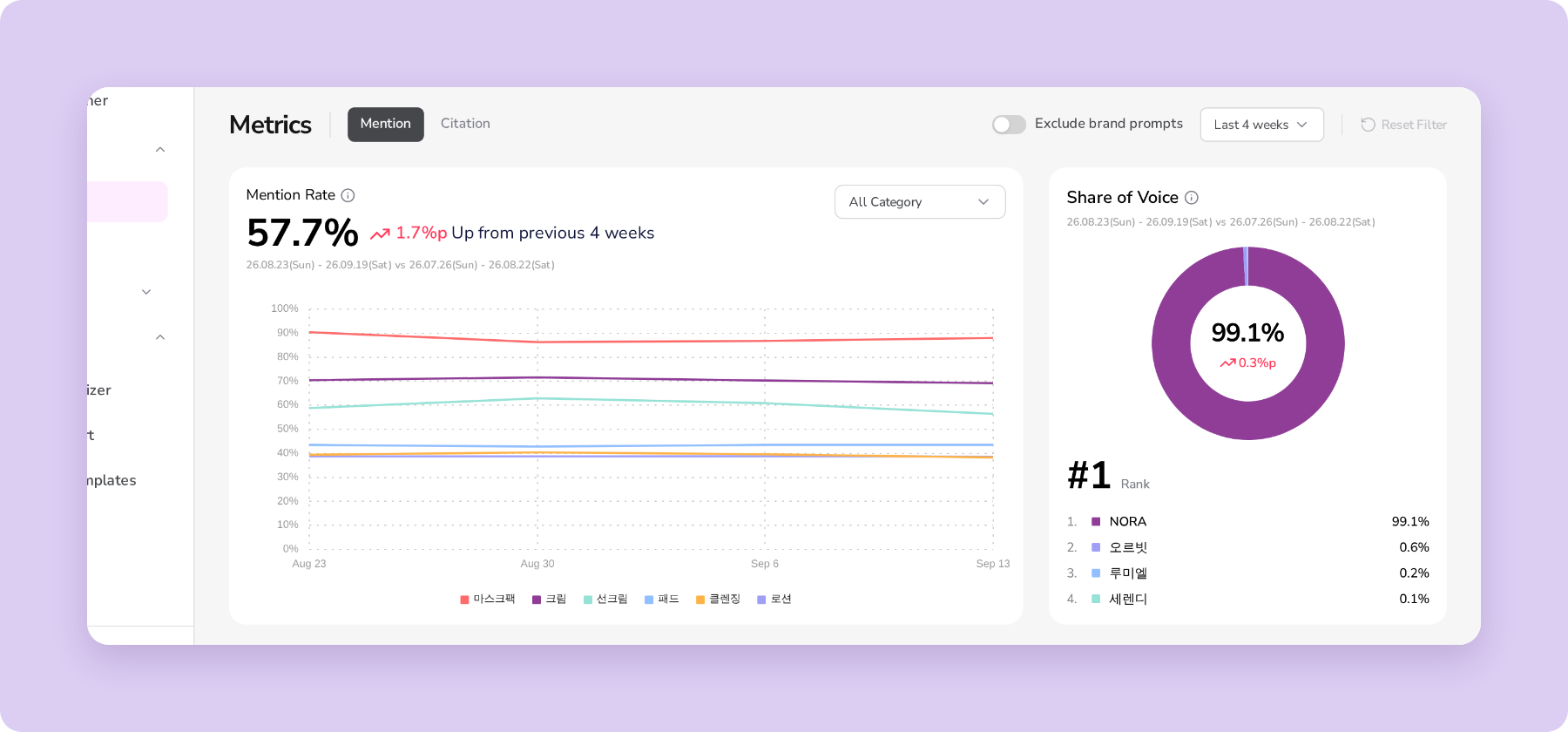
Once the customer queries are selected, use Metrics to assess your brand's overall visibility in AI search. Three key metrics are Mention Rate, Citation Rate, and Share of Voice.
| Metric | What It Measures |
|---|---|
| Mention Rate | The percentage of AI responses that mention your brand |
| Citation Rate | The percentage of AI responses that cite a URL from your registered official website domain |
| Share of Voice | Your brand's share of mentions relative to the competitors you've registered |
Together, these metrics show your brand's level of AI visibility and its position relative to competitors. If Share of Voice is particularly low for a certain topic or AI engine, the corresponding customer queries can become a priority for further analysis.
Next, use Prompt Details to examine actual AI responses to individual queries. This reveals whether your product appears among the recommendations, which features AI highlights, and which sources it references. Comparing the product attributes AI emphasizes for competitors with the information available on your own product pages helps identify content gaps worth addressing.
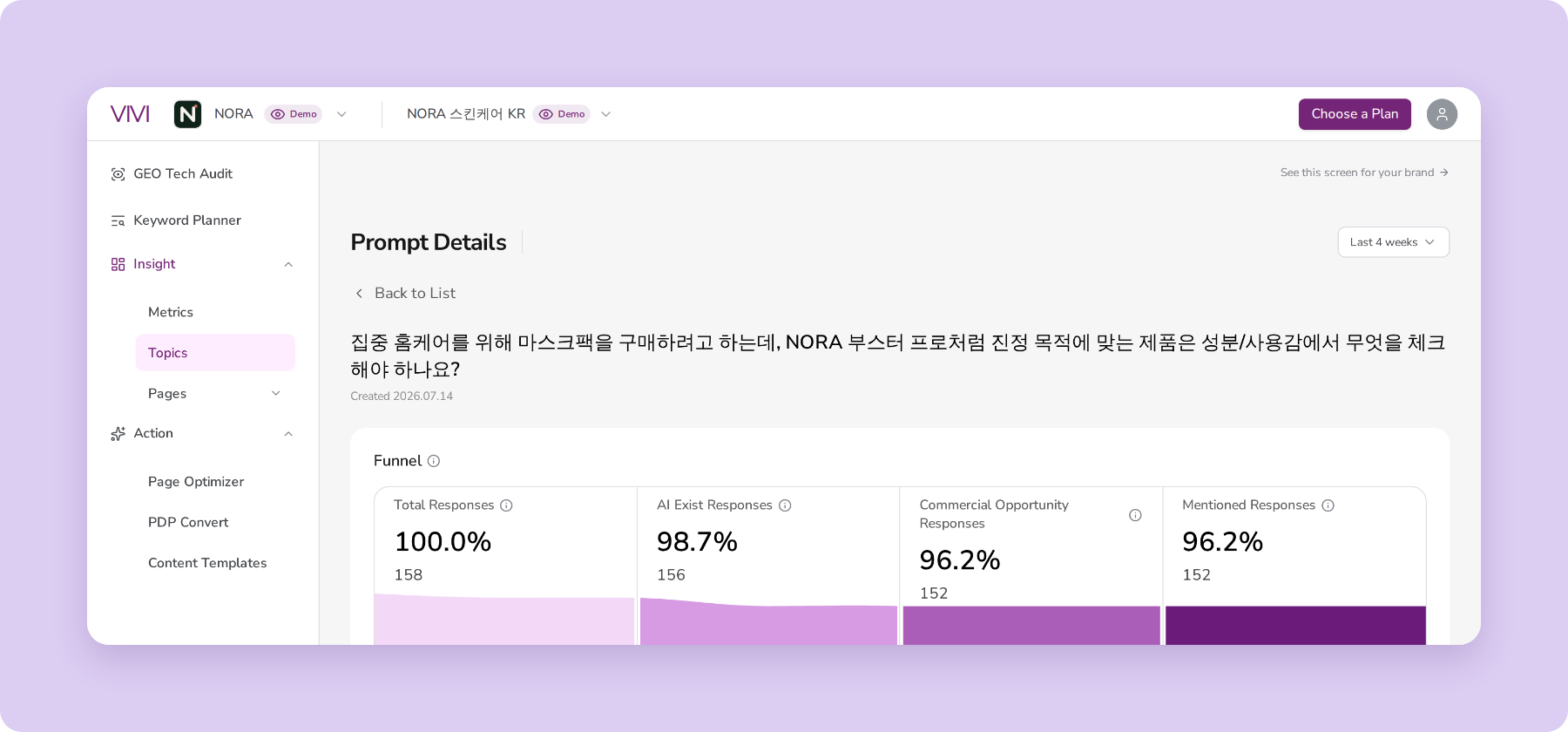
For example, suppose a competitor's product is recommended in response to "What are some quiet portable humidifiers?" You can examine the information AI uses to describe that product. If the response specifies operating noise levels or noise-reduction features, compare those details with the information provided on your own product page.
Finally, use Pages to review citations to product pages on your official website and third-party marketplaces. Establishing a baseline of citation counts and citing queries for the product pages you intend to improve makes it possible to compare performance after the updates.
VIVI calculates Citation Rate based on your registered official website domain. Citations to third-party marketplace listings, such as Coupang or Naver Store, therefore need to be tracked separately.
Use Official Website to review citations to pages on your own site, and External to monitor marketplace product pages. Both provide citation counts (Citations) and the queries associated with those citations (Citing Prompts).
Once you've reviewed AI responses and citation sources, the next step is to identify which information on your product detail pages needs improvement. In Korean ecommerce, product descriptions, specifications, and usage instructions are often presented in a single long image. However, when important information exists only within images, systems that primarily extract text from webpages may struggle to use it effectively.
Providing key product features, specifications, and instructions as HTML text and tables alongside the existing images makes that information more accessible to AI search systems.
BubbleShare's PDP Convert extracts product information from existing detail-page images and transforms it into structured text and HTML.
Start by uploading the product detail-page image to PDP Convert, then select a generation mode.
| Generation Mode | Key Features | Best For |
|---|---|---|
| Standard HTML | Reorganizes product information into sections, tables, and FAQs | Restructuring product content |
| Visual HTML | Preserves the existing design while converting text into HTML elements | Retaining the original detail-page design |
Choose Visual HTML when you want to preserve the existing visual layout while making specifications and usage information available as HTML text. Choose Standard HTML when you want to reorganize the content so customers can find relevant information more easily.
Then configure the settings for your sales channel and product category and start the conversion.
After the conversion is complete, PDP Convert displays the generated HTML content and product information for review. At this stage, verify that the information from the original images has been accurately incorporated and that the generated copy reflects the product's actual features.
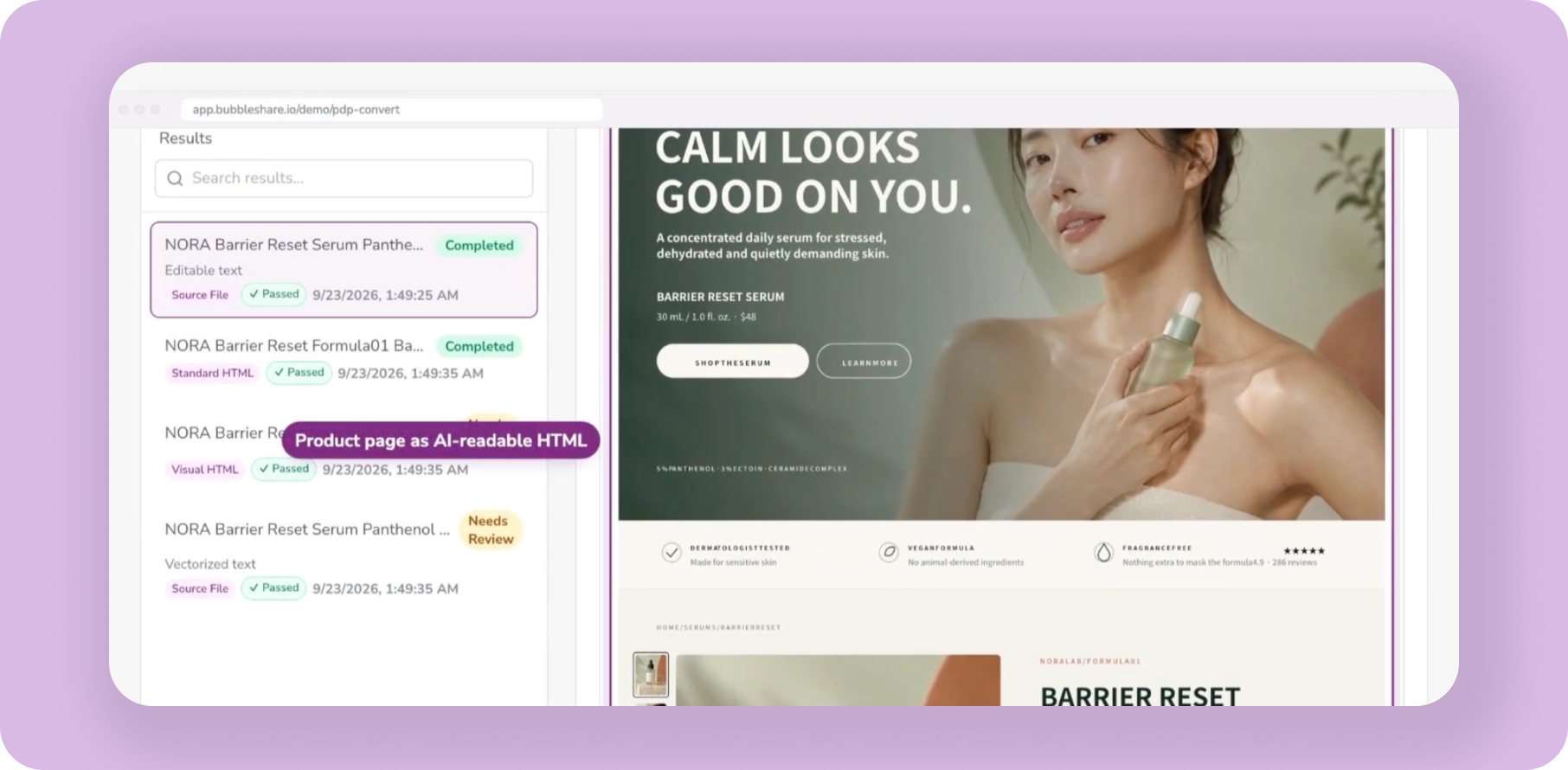
PDP Convert can also reference language from AI responses collected within the project, so it's worth checking any wording that differs from the original product description.
| Review Area | What to Check |
|---|---|
| Product Name and Description | Are the product name and key features accurate? |
| Product Specifications | Do the capacity, dimensions, and usage conditions match the actual product? |
| FAQ | Do the answers address real customer questions? |
| HTML Content | Are key details available as text and tables? |
Compare the output with official product documentation, make any necessary edits, and use Live Preview to review how the detail page will appear. Once the content has been reviewed, use Export HTML to download the completed file and apply it to your website or supported sales channels.
Because PDP Convert works with existing images, marketers can make product information easier for search systems and customers to access without rebuilding the entire product detail page.
Once the product detail page has been updated, measure performance again using the customer queries selected in Step 1. This helps determine how the updated information appears in AI responses and what to improve next.
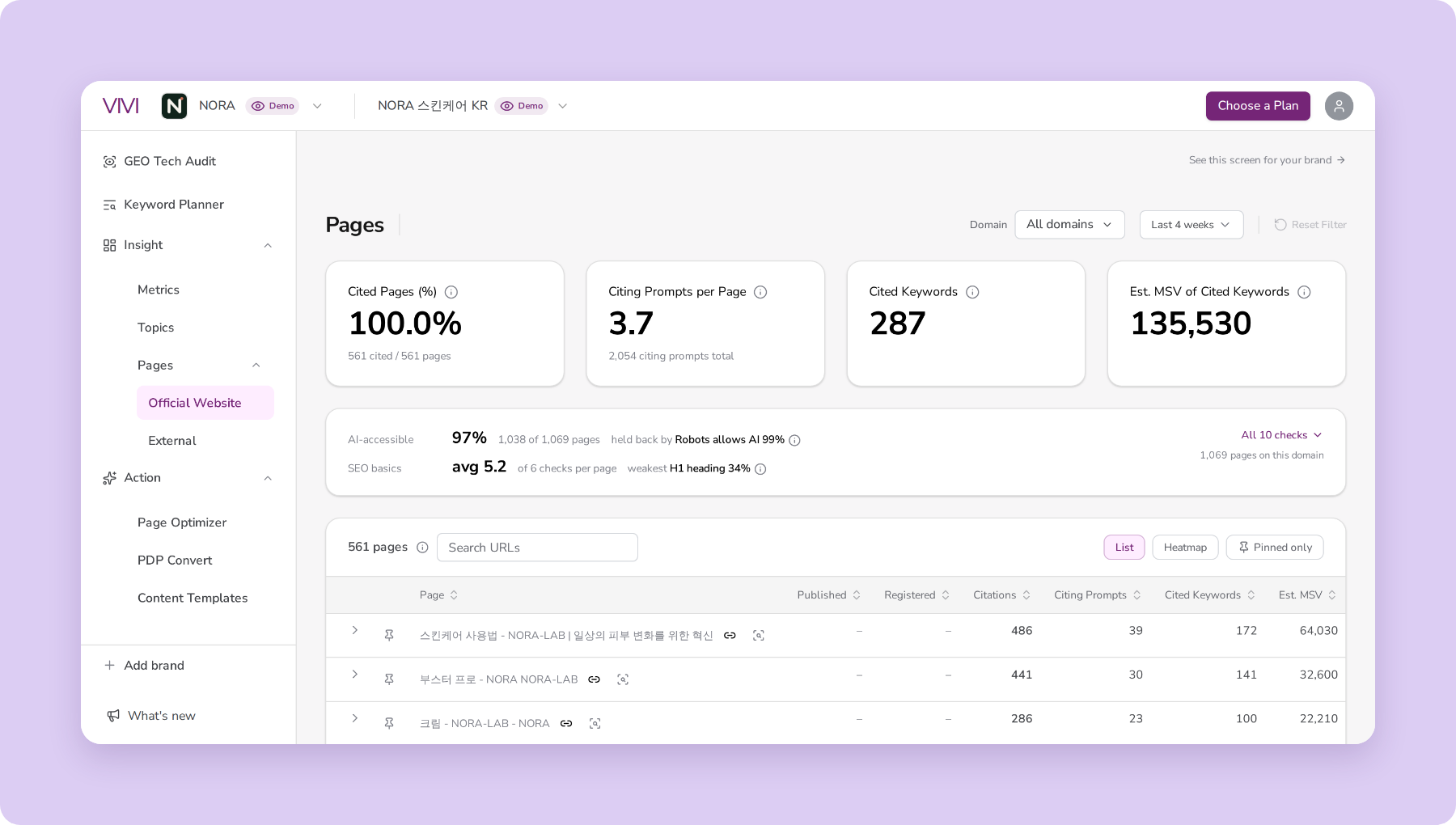
In VIVI Insight, Pages shows changes in citation counts and citing queries for the updated product page. Prompt Details lets you examine changes in product recommendations and descriptions, while Compare within Metrics allows you to compare brand Mention Rate and Citation Rate across two periods.
It's important to distinguish the citation performance of an individual product page from the overall AI visibility of your brand. Pages helps track citations to the specific URL, while Metrics shows broader changes in brand mentions and Share of Voice.
For a meaningful before-and-after comparison, keep the customer queries, AI engines, competitor set, and other measurement conditions consistent. Reviewing trends over a reasonable period alongside the actual responses provides a stronger basis for evaluating the results.
The findings can also guide the next round of improvements.
| What You Observe | What to Investigate Next |
|---|---|
| Few citations to the product page | Text accessibility and the completeness of product information |
| Competitors are repeatedly recommended instead | The product attributes and sources behind competitor recommendations |
| Citation performance differs between your website and marketplace listings | Consistency of product information across sales channels |
| Mention Rate increases but Share of Voice remains similar | Changes in competitor mentions over the same period |
By analyzing AI responses, improving product information, and measuring the results against the same customer queries, marketers can prioritize the content that needs attention next.
AI search performance can also be reviewed alongside ecommerce KPIs, such as product detail-page visits and purchase conversions. Looking at changes in both AI visibility and business outcomes helps build a more complete picture of content performance.
Preparing for agentic commerce starts with understanding what customers ask AI when searching for products and how AI describes your offerings.
With VIVI Insight, you can analyze AI recommendations and citations. PDP Convert helps you improve the product information on your detail pages. Monitoring the same queries after making changes then helps identify the next content improvements to prioritize.
See how your brand appears in AI shopping and turn those insights into practical product-page improvements.
Start Your 7-Day Free Trial of VIVI →
PDP Convert is especially useful for product detail pages where key descriptions, specifications, and usage instructions are embedded in a single long image. It converts information from those images into HTML text, making the content easier for search systems to access and use.
Providing product information as HTML text can make it easier for search systems to collect and understand. Actual recommendations and citations depend on multiple factors, so it's important to measure results again using the same customer queries after conversion.
We recommend reviewing the converted content against the product information you intend to publish. Verify specifications, usage instructions, performance claims, and other accuracy-sensitive details, then make any necessary edits before exporting the HTML.